

The first few seconds of a perfume can be exciting.
They can also be misleading.
A fragrance changes after it is sprayed. Its opening softens, different facets become more noticeable and what seemed immediately attractive may feel very different once you have worn it for a while.
That is why choosing perfume should rarely come down to one quick spray in a store.
Testing perfume well is not complicated.
It simply requires a little time, some attention and one important question:
Do I actually want to wear this again?
Here is how to find out.
Why You Should Never Judge a Perfume From the First Spray
The opening of a fragrance is exactly that: an opening.
It gives you the first impression of the composition, but not necessarily the part you will experience for most of the day.
A bright citrus opening may later become softer and warmer.
Fruit can move from crisp and luminous to something smoother or more sensual.
Vanilla may appear subtly as the fragrance develops rather than immediately.
And iris can reveal woody, creamy or powdery facets that were barely noticeable at first.
So when you spray a perfume and immediately decide “yes” or “no”, you are making a decision with incomplete information.
Give it time.
You may be surprised by what happens next.
Start on Paper, Then Move to Skin

A blotter is useful when you are discovering several fragrances.
It allows you to smell the first impression without wearing every perfume at once.
Spray the fragrance onto the blotter, wait briefly for the initial alcohol to dissipate, then smell it from a small distance rather than pressing the paper directly against your nose.
Ask yourself:
Does this make me curious enough to wear it?
That is the purpose of the blotter.
It is not necessarily where you make the final decision.
For that, move to skin.
Why Testing Perfume on Skin Matters
A perfume experienced on paper and a perfume worn on the body can feel different.
Temperature, environment and the way the fragrance develops on you can all influence your perception of it.
More importantly, wearing perfume on skin tells you something a blotter cannot:
how it feels to live with the fragrance.
Spray a small amount onto your wrist or another area of skin.
Then leave it alone.
There is no need to rub your wrists together. Simply allow the perfume to dry and develop naturally.
And resist the temptation to smell it every thirty seconds.
Wear it.
Give the Fragrance Time to Develop
Perfumes are often described through top, heart and base notes.
These descriptions are useful because they give you an idea of how a composition may evolve.
But you do not need a stopwatch.
Instead, return to the fragrance naturally during the day.
Notice what happens after the opening has settled.
Does it become warmer?
Softer?
More woody?
More floral?
Does a note appear that you had not noticed initially?
Most importantly:
Do you like what the fragrance becomes?
That question matters more than whether you can identify every individual ingredient.
If you want to understand how notes work together before testing a fragrance, our guide to how to buy perfume online explains how to use note lists and fragrance descriptions without treating them as guarantees.
Don't Test Too Many Perfumes at Once
It is tempting.
You arrive somewhere with dozens of bottles in front of you and want to smell everything.
But after several fragrances, it becomes harder to remember what belonged to which one.
Instead, narrow your selection.
Start with a few fragrances that genuinely interest you.
Use blotters first.
Then choose the one or two you most want to experience on skin.
You will learn far more from wearing a small number properly than from smelling ten fragrances in a few minutes.
Ignore the Coffee Beans
Coffee beans are frequently offered between perfumes.
You do not need them.
Coffee simply introduces another strong smell into an already scent-filled environment.
If your nose starts feeling overwhelmed, the simplest solution is usually better:
stop smelling perfumes for a while.
Step away.
Breathe normal air.
Come back later.
Testing fragrance should not feel like an endurance test.
Test Perfume in Real Life, Not Only in a Store
This is one of the biggest advantages of sampling perfume at home.
A boutique can give you a first impression.
Your everyday life gives you the real test.
Wear the fragrance while working.
Go outside.
Have dinner.
Meet someone.
Forget about it for a while.
Then notice when you become aware of it again.
Does catching the scent unexpectedly make you want to smell your wrist again?
Does it still feel like you several hours later?
Would you want someone to associate this scent with you?
These reactions are often much more useful than trying to analyse every note intellectually.
Test It More Than Once
One wear can tell you a lot.
Two or three can tell you much more.
Your mood, surroundings and even what you expected before spraying can affect your first impression.
A fragrance that seemed unusual on the first wear may become increasingly compelling.
Another may create an immediate “wow” and then lose your interest.
That is why there is no need to force an instant decision.
Wear the fragrance again on another day.
Then ask yourself:
Am I excited to spray it again?
That is one of the clearest signs that a perfume may be worth buying.
Don't Let Longevity Make the Decision for You
Performance matters.
But it is not the same thing as quality.
A perfume that lasts longer is not automatically a perfume you will enjoy more.
And different compositions naturally behave differently.
A luminous citrus fragrance may create a very different wearing experience from a deep woody or vanilla composition.
Instead of asking only:
“How long does it last?”
also ask:
“Do I enjoy the way it smells while I am wearing it?”
There is little value in extraordinary longevity if you no longer enjoy the fragrance.
Choose pleasure first.
Stop Trying to Find the “Most Impressive” Perfume
This is where perfume testing becomes much easier.
You do not need to choose the most complex fragrance.
Or the strongest.
Or the one someone else considers the most sophisticated.
You are looking for the one that creates a reaction in you.
If you are still defining your personal fragrance style, our guide to choosing the best niche perfume for you can help you identify the profiles you naturally return to.
Perhaps it feels effortless.
Perhaps it surprises you.
Perhaps you keep bringing your wrist back toward your nose without thinking about it.
Perhaps you simply feel better wearing it.
That emotional pull is worth paying attention to.
Because ultimately, perfume is worn, not analysed.
The Best Way to Test Perfume at Home
At home, remove the pressure to decide immediately.
Choose one or two samples.
Wear one fragrance on skin.
Experience the opening.
Continue with your day.
Return to it later.
Then try it again another day.

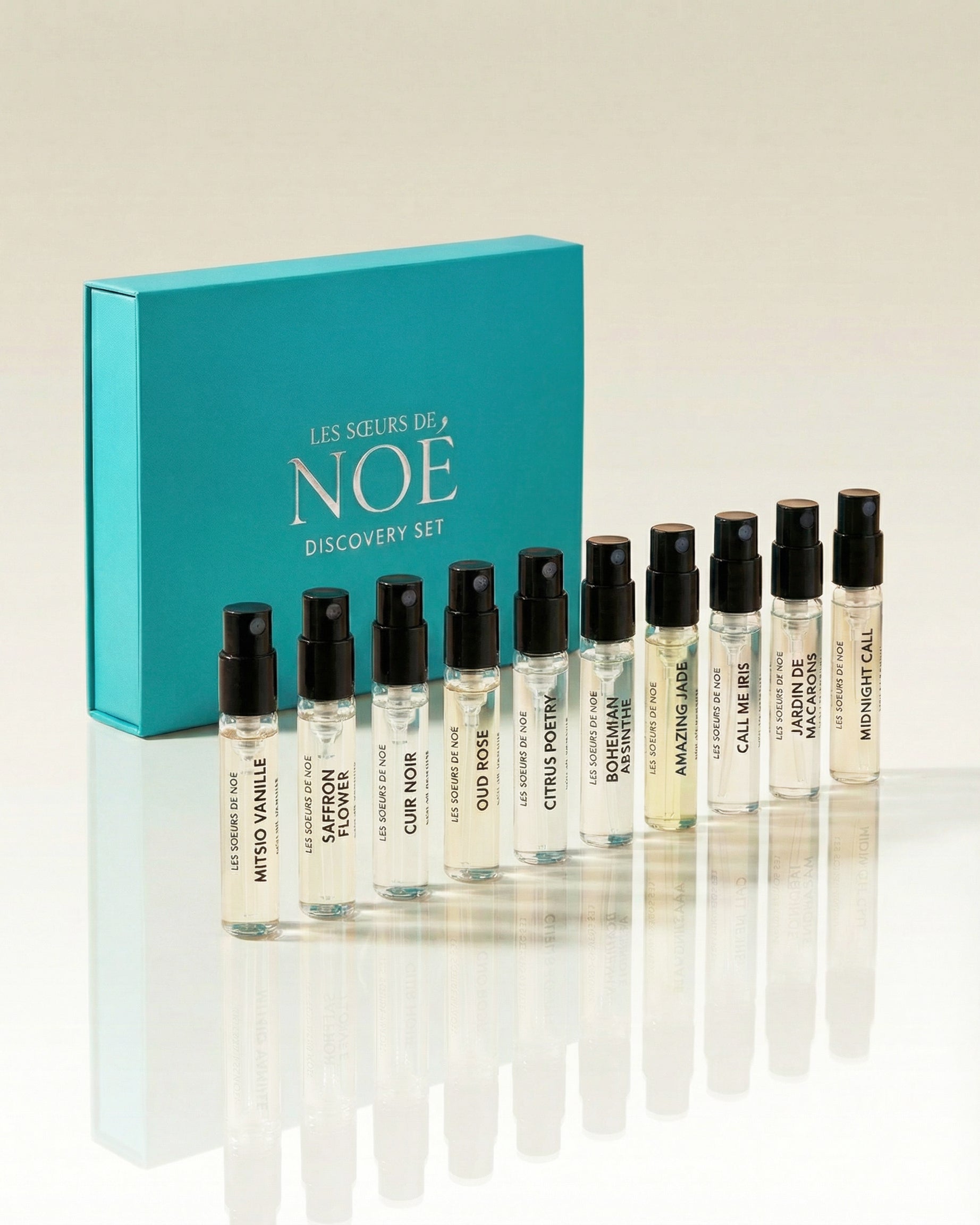
At Les Soeurs de Noé, our Discovery Set allows you to explore several fragrances from the Maison before committing to a full bottle.
If you already know which olfactive directions interest you, you can also create your own Sample Box.
The objective is not to “study” every perfume.
It is to discover which one you miss when you are not wearing it.
A Simple Perfume Testing Checklist
| When testing | Ask yourself |
|---|---|
| First spray | Does the fragrance make me curious? |
| On skin | Does it feel good to wear rather than simply smell? |
| Later | Do I enjoy how it develops? |
| In everyday life | Does the fragrance feel natural on me? |
| Second wear | Am I looking forward to wearing it again? |
| Before buying | Would I genuinely reach for this bottle? |
If the answer to the final question is yes, you are probably much closer to your decision than any list of notes could take you.

How Do You Know You've Found the Right Perfume?
Not because someone tells you it is exceptional.
Not because it has the longest list of ingredients.
And not because it lasted the most hours.
You know because you want to return to it.
You notice it during the day.
You want to smell it again.
You find yourself reaching for the sample without having to think about it.
At some point, you stop testing the fragrance.
You simply start wearing it.
And that is usually when you know.
Frequently Asked Questions
Should I test perfume on paper or skin?
Use paper as a first filter when comparing fragrances, but test the perfumes you are seriously considering on your skin before making a full-bottle decision.
How many perfumes should I test at once?
There is no universal number. The important thing is to stop when the fragrances begin to blur together. Testing a small number carefully is usually more useful than trying to smell many fragrances in one session.
Should I rub my wrists together after spraying perfume?
There is no need. Let the fragrance dry naturally on your skin and experience how it develops.
How long should I wait before deciding whether I like a perfume?
Do not judge only the first spray. Wear the fragrance for a while and experience how it develops. If possible, try it again on another day before making a full-bottle decision.
Do coffee beans reset your sense of smell?
They are commonly used in perfume stores, but you do not need them. Taking a break and returning to normal, unscented air is a simpler way to avoid becoming overwhelmed.
Does perfume smell different on different people?
People can perceive and experience the same fragrance differently. Testing a perfume on your own skin is therefore much more useful than relying only on another person's description.
How do I know if a perfume is worth buying?
Ask yourself whether you genuinely want to wear it again. If you repeatedly return to a sample and enjoy how it feels throughout the wear, that is a much stronger buying signal than the initial spray alone.


Laisser un commentaire
Ce site est protégé par hCaptcha, et la Politique de confidentialité et les Conditions de service de hCaptcha s’appliquent.