

A perfume begins long before the first spray.
Before the bottle.
Before the packaging.
Before a finished formula even exists.
It begins with an idea.
A memory.
A place.
A texture.
A feeling the creator wants to translate into scent.
From there, the process moves through several stages: creative direction, formulation, evaluation, production, resting, filtration, filling and packaging.
The exact journey differs from one perfume to another.
But understanding the process reveals something important:
perfume is not simply mixed and bottled. It is developed through a sequence of creative and technical decisions.
Here is how that journey works.
1. It Starts With an Idea
A fragrance usually begins with a creative direction.
That direction may be inspired by:
a memory
a place
a moment
a material
a colour
a texture
an atmosphere
The objective is not yet to decide every ingredient.
It is to define what the fragrance should express.
That idea becomes the starting point for the perfumer.
2. The Fragrance Brief Gives the Idea Structure
The creative vision is translated into a fragrance brief.
A brief can describe:
- the intended mood
- olfactive directions
- textures
- contrasts
- references
- emotions
- the type of presence the fragrance should have
It gives the perfumer a framework without replacing their creative interpretation.
A good brief does not simply say:
“Make something floral.”
It tries to communicate:
What kind of floral?
How should it feel?
What should make it memorable?
That distinction is where fragrance creation begins to become interesting.

3. The Perfumer Begins to Compose
The perfumer works with a palette of natural and synthetic fragrance materials.
Some materials may provide richness or texture.
Others may create transparency, diffusion, freshness, warmth or contrast.
The objective is not to maximise one category of ingredients.
It is to build a coherent composition.
This is one reason the debate between natural and synthetic materials can be misleading.
Modern perfumery uses both.
If you want to understand that relationship in more detail, read Natural vs Synthetic Ingredients in Perfume: What Really Matters?.

4. The First Formula Is Rarely the Final One
Fragrance development is iterative.
A first version may capture the idea but feel too bright.
Another may have the right opening but not the desired drydown.
A later modification may change only one part of the composition yet alter the overall impression significantly.
The creator and perfumer smell.
Compare.
Discuss.
Modify.
Then smell again.
This can continue until the fragrance feels aligned with the original vision.
There is no universal number of modifications required.
Some projects move quickly.
Others require more exploration.
The important part is not the number of trials. It is the quality of the final decision.
5. Perfume Is Evaluated on More Than the First Spray
A fragrance changes after application.
More volatile materials may be perceived first.
Other facets become clearer later.
That is why evaluation cannot rely only on the opening.
The perfumer and creative team may consider:
- the first impression
- the heart of the fragrance
- the drydown
- balance
- diffusion
- texture
- overall character
The aim is not simply to make the opening impressive.
It is to create a fragrance worth continuing to smell.
6. The Formula Is Prepared for Production
Once the formula is approved, the creative development moves toward manufacturing.
At this stage, the fragrance concentrate is produced according to the validated formula.
That concentrate is then combined with the appropriate base for the finished perfume.
The exact production process can vary according to the fragrance, manufacturer and format.
This is where creative work becomes repeatable production.
Consistency matters.
The fragrance that reaches the customer should remain faithful to the approved creation.
7. What Are Maceration and Maturation?
These words are often surrounded by mythology.
In simple terms, fragrance production can include periods during which the concentrate or finished alcoholic mixture is allowed to rest.
The precise process depends on the manufacturer and formula.
It is better not to imagine this stage as a magical transformation where “more time automatically means better perfume.”
Time is part of the manufacturing process.
But quality cannot be measured simply by counting the number of weeks a fragrance rested.
8. The Fragrance Is Filtered and Prepared for Filling
Before filling, the finished perfume may go through filtration or other finishing steps appropriate to the formula and production process.
The objective is practical:
to prepare the perfume for consistent presentation and filling.
After that, the fragrance can move into its final container.
9. The Bottle Is Part of the Experience
Perfume is invisible.
The bottle gives it a physical presence.
Its proportions, weight, cap, label, glass and packaging all influence how the fragrance is experienced before it is even sprayed.
But packaging should not be confused with perfume quality.
A beautiful bottle cannot rescue a fragrance you do not want to wear.
And a remarkable fragrance does not become more interesting simply because its packaging is elaborate.
The strongest luxury experience happens when:
the fragrance and the object feel like they belong together.
10. From Formula to Finished Product
Once the perfume has been prepared and approved for filling, it moves into packaging.
Bottle.
Pump.
Cap.
Label.
Box.
Each element has to come together into a finished product ready to leave production.
At this stage, the fragrance that once existed only as an idea has become something tangible.
That transformation is what makes perfume development fascinating.
A memory or creative instinct has travelled through:
brief → formulation → evaluation → production → bottle.
How Les Soeurs de Noé Approaches Creation
At Les Soeurs de Noé, fragrance begins with emotion and storytelling.
The creative direction comes before the formula.
The goal is not to create a perfume around a technical specification alone, but to give the perfumer a world to interpret.
Our fragrances are made in France, vegan and cruelty-free, with more than 85% ingredients of natural origin.
But those facts do not replace the final test.
Does the fragrance create something you want to experience again?
That remains the most important question.
Why the Final Fragrance Matters More Than the Process
It is easy to romanticise perfume manufacturing.
Rare ingredients.
French ateliers.
Glass bottles.
Long development.
But none of those elements automatically guarantees that you will love what is inside.
The process matters because it supports the creation.
It should never become a substitute for the fragrance itself.
Ultimately, you experience the result on your skin.
Not the brief.
Not the formula sheet.
Not the production line.
The perfume.

Experience the Result Before Choosing a Full Bottle
Understanding how perfume is created can make fragrance more interesting.
But the best way to understand a finished composition is still to wear it.
At Les Soeurs de Noé, you can explore fragrance before committing to a full bottle.
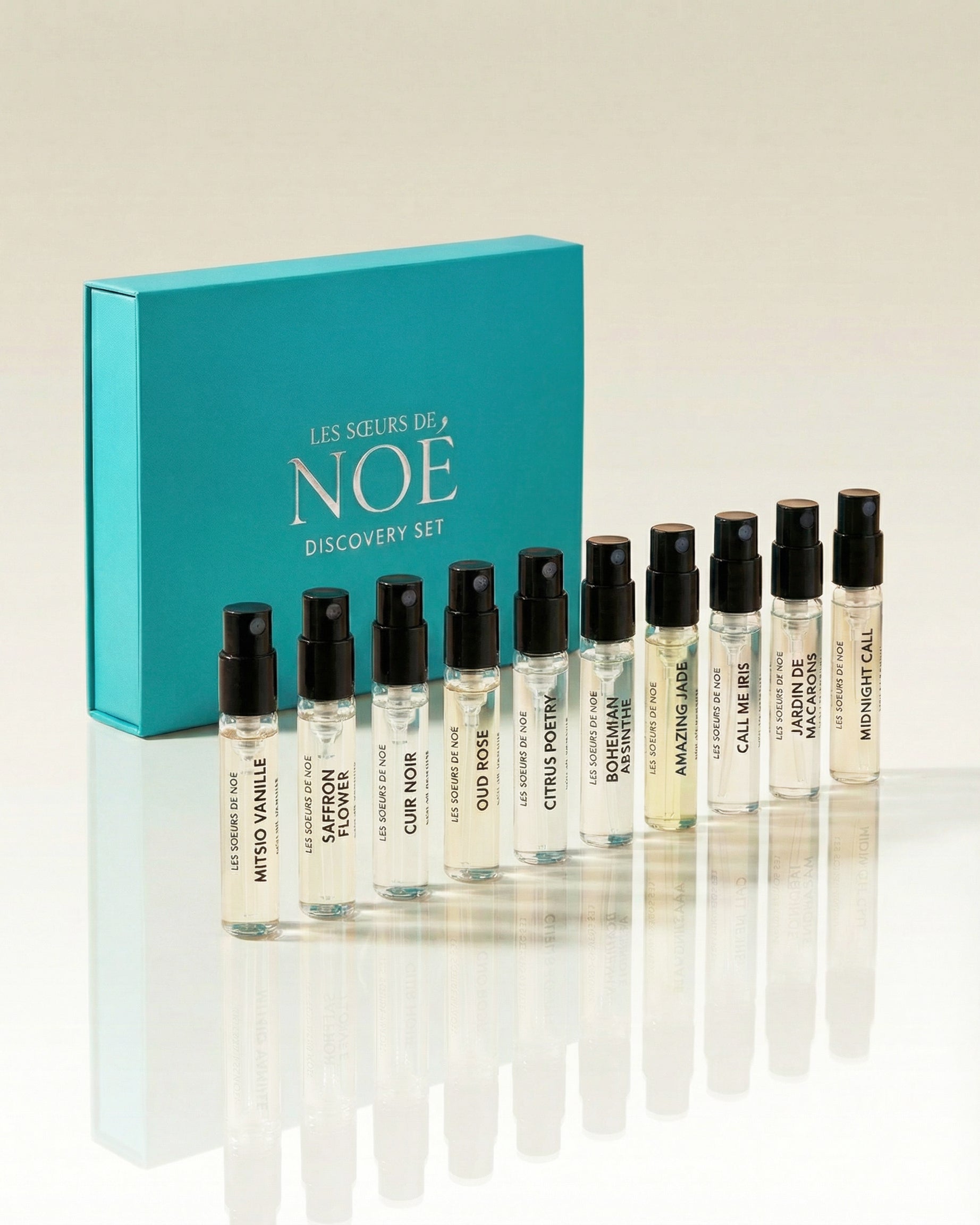
Discovery Set
10 × 2 ml - €55
Discover ten fragrances from the Signature Collection and experience different creations at home.
The Discovery Set includes a €50 voucher toward an eligible order over €150.
Sample Box
8 × 2 ml - €50
Prefer to create your own selection?
Choose eight samples and compare the fragrances that interest you most.
The Sample Box also includes a €50 voucher toward an eligible order over €150.
For a more detailed method, read How to Test Perfume Like an Expert.
From Idea to Skin
A perfume may begin as something intangible.
A memory.
An atmosphere.
A sentence.
But creating it requires decisions at every stage.
The idea needs to become a brief.
The brief becomes a formula.
The formula is refined.
The fragrance moves into production.
And eventually, the finished composition reaches the skin.
That is where the creative process ends.
And your experience begins.
Frequently Asked Questions
How does a perfume begin?
Most fragrance projects begin with a creative idea or brief describing the direction, emotion or olfactive world the finished scent should express.
What is a fragrance brief?
A fragrance brief communicates the creative direction to the perfumer. It may include mood, references, desired olfactive directions, textures and other elements intended to guide the composition.
Who creates the perfume formula?
A perfumer develops the fragrance formula using a palette of fragrance materials and refines it through evaluation and modification.
How many versions of a perfume are created?
There is no universal number. Development is iterative and continues until the relevant creative and technical requirements have been met.
Are luxury perfumes made only with natural ingredients?
No. Modern perfumery frequently combines natural and synthetic fragrance materials.
What is maceration in perfume?
The term generally refers to a resting stage during fragrance production. The exact process and duration vary according to the formula and manufacturer.
Does longer maceration automatically make perfume better?
No. Time alone is not a quality measure. The formulation and manufacturing process as a whole matter more.
Why is perfume filtered before bottling?
Filtration can be part of preparing the finished fragrance for filling and consistent presentation, depending on the formula and manufacturing process.
Does higher concentration automatically mean better perfume?
No. Concentration describes one aspect of the formula. It does not by itself determine quality, projection or longevity.
What is the best way to evaluate the finished perfume?
Wear it. Experience the opening, development and drydown, and decide whether you genuinely want to return to the fragrance.


Leave a comment
This site is protected by hCaptcha and the hCaptcha Privacy Policy and Terms of Service apply.