

Some perfumes attract more compliments because they combine four things particularly well: they can be noticed without becoming overwhelming, they are pleasant enough to invite attention, they have something distinctive people remember, and they are worn in a context where others can actually perceive them.
Projection and sillage matter, but neither guarantees compliments.
Price does not guarantee them.
A higher perfume concentration does not guarantee them.
And a niche fragrance is not automatically more compliment-worthy than a designer fragrance.
The perfumes people notice most successfully tend to sit somewhere between familiarity and surprise: easy enough to understand, but interesting enough to make someone wonder:
What are you wearing?
That difference between simply being smelled and genuinely creating curiosity is what makes the subject of compliment-getting perfumes more interesting than it first appears.
What Actually Makes a Perfume Get Compliments?

There is no formula that can guarantee a compliment.
Fragrance is too personal for that.
But there are several factors that can increase the likelihood that another person notices a perfume positively.
A useful way to think about it is what we call the Compliment Equation:
Noticeability × Likeability × Distinctiveness × Context = Compliment Potential
This is not a scientific equation.
It is a practical framework for understanding why some fragrances seem to generate reactions more easily than others.
| Factor | Why It Matters |
|---|---|
| Noticeability | Someone has to perceive the fragrance before they can react to it |
| Likeability | Being noticeable is not the same as smelling pleasant |
| Distinctiveness | A memorable detail can create curiosity |
| Context | Distance, environment, temperature and the people around you all matter |
A fragrance that performs strongly in only one area may still receive very few compliments.
A perfume can be extremely noticeable but too intrusive.
Another may smell beautiful but remain so close to the skin that few people encounter it.
Another may be unusual enough to be remembered, but polarising rather than attractive.
Compliments usually happen somewhere in the balance between these factors.
Being Noticed Is Not the Same as Being Complimented
One of the biggest misconceptions about compliment-getting perfume is that stronger automatically means better.
It does not.
A fragrance can fill a room and still receive no compliments.
In fact, being extremely noticeable can sometimes work against a perfume if people experience it as overwhelming.
The more useful distinction is this:
Noticeability gets attention. Likeability creates the compliment.
A perfume needs enough presence to be perceived, but it also needs to remain pleasant within the space around the wearer.
This is why a fragrance with moderate projection can sometimes attract more positive attention than one with enormous projection.
The goal is not necessarily to make everyone in the room smell you.
It is to create enough presence that the fragrance becomes part of the encounter.
Sillage vs Projection: Which Matters More for Compliments?

Sillage and projection are often used interchangeably, but they describe different aspects of how perfume moves through space.
What Is Perfume Projection?
Projection describes how far a fragrance appears to radiate from the wearer at a particular moment.
You can think of it as the scented space surrounding the body.
Some perfumes remain close to the skin.
Others create a more noticeable scent bubble.
What Is Perfume Sillage?
Sillage describes the trail a fragrance leaves behind as the wearer moves.
It is the scent someone may notice after you walk past them or leave a room.
The two are related, but they are not identical.
A perfume can project strongly at first and later settle into a more discreet trail.
Another may feel relatively quiet when you are standing still but become noticeable as you move.
Which Gets More Compliments?
Neither guarantees compliments.
Projection can help someone notice you when you are nearby.
Sillage can create curiosity after you pass.
What matters more is whether the fragrance reaches other people at a pleasant level.
A huge scent trail is not automatically more attractive than a subtle one.
The best compliment potential often appears when a fragrance is perceptible without demanding attention.
Does Stronger Perfume Get More Compliments?
Not necessarily.
More fragrance can increase noticeability, but it can also push a perfume beyond what feels comfortable in a shared space.
Think of fragrance intensity as a spectrum.
Too little:
The perfume may be beautiful, but few people can smell it.
Balanced:
The fragrance is perceptible, but still feels integrated with the wearer.
Too much:
The perfume may dominate the environment rather than invite curiosity.
We can call the middle area the Compliment Zone.
It is not a fixed number of sprays.
Every fragrance behaves differently.
A fresh citrus composition, a dense amber fragrance and an intimate musk perfume may require completely different application levels.
Environment also matters.
What works outdoors may feel excessive in a small restaurant, car, office or lift.
So instead of asking:
How many sprays get the most compliments?
A better question is:
How much of this particular perfume creates a noticeable but comfortable presence?
Does Perfume Concentration Affect Compliments?
Perfume concentration can influence the way a fragrance wears, but concentration alone cannot predict how many compliments it will receive.
An Eau de Parfum may contain a higher proportion of fragrance concentrate than an Eau de Toilette, but that does not automatically mean it will project farther.
Likewise, an extrait or highly concentrated perfume is not guaranteed to be louder.
Some highly concentrated fragrances wear very close to the skin.
Some lighter concentrations feel bright and expansive.
The finished formula matters.
The materials matter.
The balance between volatile and slower-moving components matters.
Application and environment matter too.
So while concentration can tell you something about how a perfume was constructed, it cannot tell you whether other people will notice it or enjoy it.
If you want to understand the difference between EDP, EDT, parfum and extrait in more detail, read our guide to Perfume Concentrations Explained.
Why Do Sweet, Musky and Familiar Scents Often Get Attention?
Many perfumes described as compliment-getters contain notes that feel immediately recognisable.
Vanilla.
Musk.
Amber.
Fruits.
Soft florals.
Woods.
These notes are not universally attractive, and there is no ingredient that automatically creates compliments.
But familiarity can make a fragrance easier to process.
A perfume that contains something recognisable may feel immediately approachable.
The interesting part often comes from what happens next.
Perhaps the vanilla is paired with salt.
The pear is paired with woods.
The musk is brightened by citrus.
The rose becomes darker through spice.
That creates what we can call the Familiarity - Curiosity Balance.
A perfume can feel:
familiar enough to understand,
different enough to remember.
That combination is one reason some fragrances attract repeated questions.
The person smelling them recognises something they enjoy but cannot immediately identify the entire composition.
That gap creates curiosity.
Do Unique Perfumes Get More Compliments?
Being unusual can make a perfume memorable.
But memorable and compliment-worthy are not the same thing.
A fragrance can be fascinating without being widely attractive.
This is one reason extremely experimental perfumes sometimes generate fewer compliments than more accessible compositions.
At the opposite end, a fragrance that feels completely familiar may be easy to like but may not trigger the question:
What is that?
The most complimented perfume for one person may therefore sit somewhere between the two extremes.
Not generic.
Not deliberately strange.
Just distinctive enough to feel personal.
This is also why the idea of a single “most complimented perfume in the world” is misleading.
The wearer, setting and audience are always part of the equation.
Why Does the Same Perfume Smell Different on Different People?
Anyone who has borrowed a friend's perfume has probably experienced this.
A fragrance can smell beautiful on someone else and noticeably different on your own skin.
The common phrase used to describe this is skin chemistry, although the reality is more complicated than a single pH measurement.
Several things can influence how you experience a fragrance on different people:
-
body temperature;
-
natural body odour;
-
application amount;
-
where the perfume is applied;
-
whether it is sprayed on skin or clothing;
-
how much time has passed since application;
-
environment and temperature;
-
individual perception.
This is why testing perfume directly on your own skin is useful.
A paper blotter can show you the general direction of a fragrance.
Skin shows you how you experience it when you actually wear it.
And because compliments involve other people experiencing your fragrance around you, wearing the perfume in real life tells you much more than smelling it for thirty seconds in a store.
Does Dry Skin Make Perfume Disappear Faster?
You will often hear the advice that fragrance lasts better on moisturised skin.
That can be useful for some people, but it should not be treated as a universal rule.
Fragrance performance varies significantly between formulas and wearers.
If your skin tends to feel dry, you can experiment with applying an unscented moisturiser before fragrance and compare the result.
What matters is the result on your own skin.
Perfume advice works best when it gives you something to test rather than presenting personal experience as a law.
Can Other People Smell Your Perfume When You Can't?
Yes, they sometimes can.
When you are exposed to the same smell continuously, your perception of it can decrease.
This is often described as olfactory adaptation or nose blindness.
It means you may stop noticing your own perfume as clearly even while another person entering the room can still perceive it.
This is important because one common reaction to not smelling your perfume is to apply more.
And then more.
And then more.
That can easily move a fragrance beyond the comfortable Compliment Zone.
If you stop noticing your perfume after wearing it for a while, do not automatically assume it has disappeared.
Pay attention to how it behaves earlier in the day, test different application amounts, or ask someone you trust whether they can still smell it.
Does Expensive Perfume Get More Compliments?
There is no reason to assume that a higher price automatically means more compliments.
Price can reflect many things:
-
ingredients;
-
packaging;
-
distribution;
-
development;
-
production scale;
-
brand positioning;
-
design;
-
retail structure.
But price alone does not determine whether another person will enjoy the smell.
The perfume receiving the most compliments in your collection may be the most expensive bottle you own.
Or it may not be.
Compliments respond to the experience of the fragrance, not the receipt.
Do Niche Perfumes Get More Compliments Than Designer Perfumes?
Not inherently.
Niche and designer perfumery can both produce fragrances with strong projection, soft projection, familiar profiles, unusual profiles, broad appeal or highly specific character.
A niche label does not guarantee originality.
A designer label does not guarantee predictability.
And neither category guarantees compliments.
The useful question is not:
Is this niche or designer?
It is:
Does this fragrance create the kind of presence I enjoy wearing?
If uniqueness matters to you, niche perfume can offer interesting directions to explore.
But choosing fragrance purely to appear more unusual is rarely the best way to find something you genuinely want to wear.
Do Gourmand Perfumes Get More Compliments?
Gourmand perfumes are frequently discussed as compliment-getters because many use familiar edible associations such as vanilla, caramel, chocolate, coffee, fruit or creamy notes.
But not every gourmand smells sweet.
And not everyone enjoys sweet perfume.
A gourmand composition can feel:
-
airy;
-
fruity;
-
creamy;
-
woody;
-
spicy;
-
dark;
-
dry;
-
intensely sweet.
So gourmand is not a shortcut to compliments.
What matters is how the gourmand effect is balanced within the composition.
A perfume that creates appetite or familiarity without becoming overwhelming may feel especially approachable.
But another wearer may receive more compliments from a crisp floral, green fragrance or woody musk.
The category alone cannot predict the reaction.
What Perfume Notes Get the Most Compliments?
There is no reliable universal ranking of perfume notes by compliments.
That is partly because people do not smell isolated notes.
They smell compositions.
Vanilla inside one perfume may feel warm and edible.
In another, it may feel dry and woody.
Pear may feel crisp and fresh, or ripe and gourmand.
Rose may feel luminous, spicy, dark or almost fruity.
Musk may feel clean, warm, powdery or intimate.
So asking:
Which note gets the most compliments?
can be less useful than asking:
Which style of fragrance creates the reaction I want?
You may discover that you respond most strongly to:
-
juicy fruity fragrances;
-
creamy gourmands;
-
clean musks;
-
luminous florals;
-
warm amber scents;
-
deep woody perfumes;
-
fresh aromatic compositions.
The pattern across several perfumes tells you more than one ingredient.
Can Too Much Perfume Reduce Compliments?
Absolutely.
A fragrance can move from attractive to intrusive when it overwhelms the space around it.
This does not mean strong perfumes should be avoided.
It means application should match the perfume and the context.
A scent worn outside can behave differently from the same perfume in a small room.
A fragrance worn at dinner may need a different application from one worn at an outdoor event.
And a perfume with large projection may require less application than an intimate skin scent.
There is no universal “compliment-worthy” spray count.
If you want a more detailed method, read How Many Sprays of Perfume Should You Wear?
Does Weather Affect How Noticeable Perfume Feels?
Temperature can influence the way a perfume appears to move and develop.
Warm environments can make some fragrances feel more expansive.
Cold conditions can change how readily you perceive certain parts of the composition.
But again, the effect depends on the perfume.
That is why seasonal recommendations should be treated as guidance rather than rules.
Some people happily wear rich amber fragrances in summer.
Others prefer them only in colder weather.
Some love citrus all year.
Others stop reaching for it in winter.
The best approach is to notice how your perfume behaves in the conditions where you actually wear it.
Does a Perfume Need Strong Sillage to Be Attractive?
No.
Some fragrances are intentionally intimate.
They create a smaller scent space close to the wearer.
These perfumes may receive fewer comments from strangers simply because fewer strangers encounter them.
But that does not make them less attractive.
A skin scent can create an extremely compelling experience at close distance.
This is another reason “most complimented” should never be confused with “best”.
A fragrance designed to be discovered closely is doing a different job from one designed to leave a large trail.
What Is the Difference Between an Attractive Perfume and a Compliment-Getting Perfume?
An attractive perfume is one you or another person enjoys smelling.
A compliment-getting perfume also creates enough opportunity for someone to express that reaction.
That requires:
perception + positive response + social opportunity.
Someone may love your perfume and say nothing.
Someone may notice it but never ask.
A stranger may be less likely to comment than a friend.
This is why compliments are an imperfect measure of fragrance quality.
They can be fun.
They can help confirm that a fragrance creates presence.
But they should not become the only reason to choose what you wear.
Should You Choose a Perfume Based on Compliments?
Not entirely.
A perfume spends far more time with you than with the people around you.
If everyone compliments a fragrance but you do not enjoy wearing it, it is probably not the right perfume for you.
Compliments can be useful information.
They can tell you that a fragrance is noticeable.
They can reveal that other people respond positively to it.
But the more important question remains:
Do I want to keep smelling this on myself?
That is what turns a compliment-getter into a fragrance you genuinely want to own.
How to Test Whether a Perfume Works for You
If you want to find a fragrance that feels good on you and has the potential to be noticed positively, test it in real life.
1. Smell It First
Use a blotter if you want an initial impression.
Do not make the final decision there.
2. Wear It on Skin
Give the fragrance time to develop.
Notice what remains once the opening settles.
3. Wear It More Than Once
Novelty can make a perfume feel exciting on the first wear.
Repeated wear tells you whether that excitement lasts.
4. Wear It in Your Normal Environment
Work.
Dinner.
Walking outside.
An evening with friends.
Your normal life tells you far more than a perfume counter.
5. Notice Your Own Reaction
Do you keep smelling your wrist?
Do you want to wear it again?
Would you miss the sample if it disappeared?
6. Notice Other People's Reactions Without Chasing Them
A compliment can be interesting.
But do not overspray simply to create one.
The best reactions often happen when the fragrance feels natural rather than performative.
How to Choose a Perfume People Will Remember
Instead of searching only for the “most complimented perfume”, look for a fragrance that balances several qualities.
Ask:
Can people perceive it?
Do I enjoy the scent myself?
Does it have something distinctive?
Can I imagine wearing it naturally?
Does it suit the environments where I spend time?
Do I want to smell it again tomorrow?
That last question may be the most important.
The perfume people remember most is often not the one that makes the biggest entrance.
It is the one that feels connected to the person wearing it.
Finding Your Own Compliment-Worthy Fragrance

At Les Soeurs de Noe, we prefer discovery before commitment.
Our fragrances are made in France, vegan and cruelty-free, with more than 85% ingredients of natural origin.
But none of those facts can tell you which fragrance will work best on your skin or become the one you genuinely want to keep wearing.
Only experience can do that.
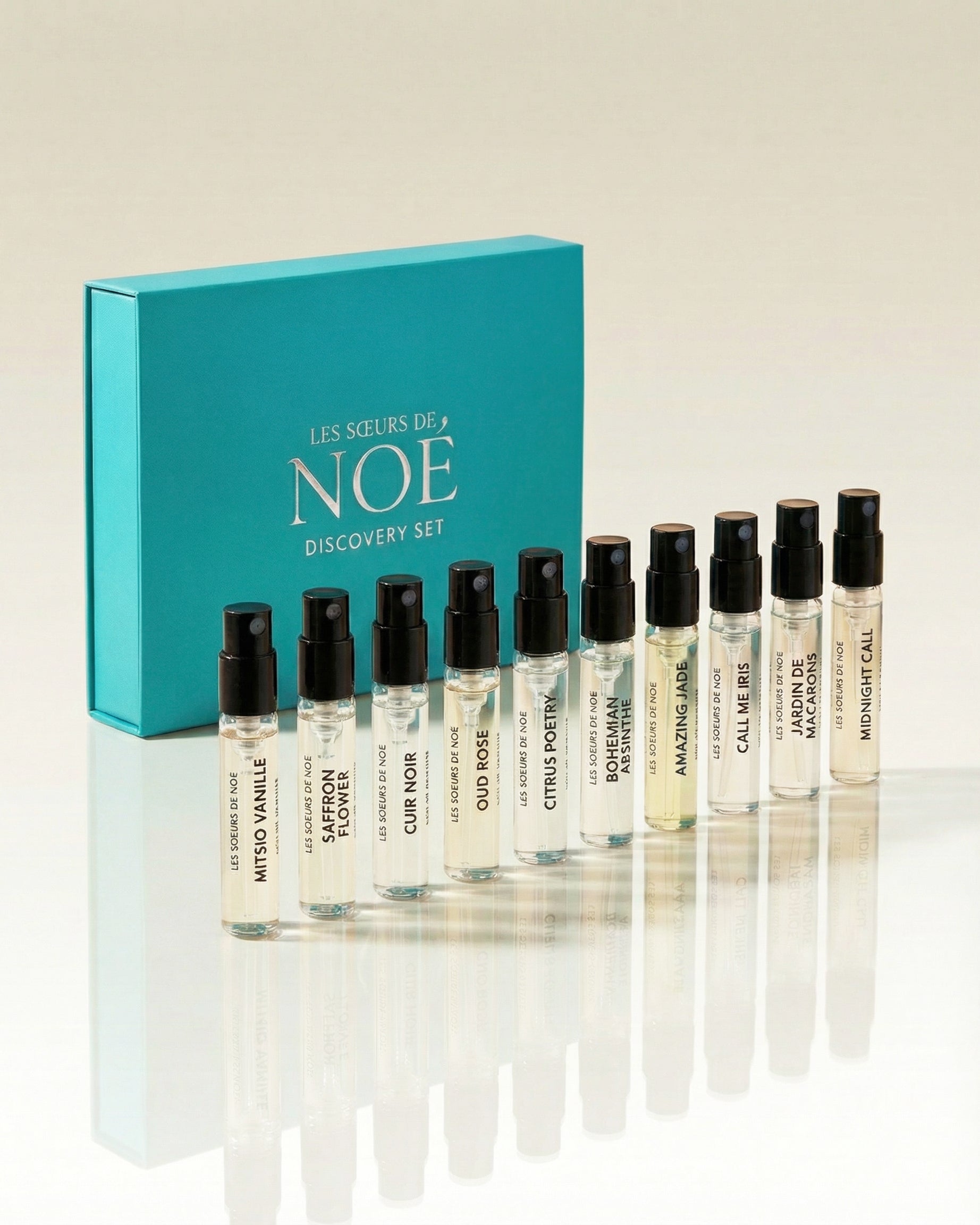
If you want to explore several compositions before choosing a full bottle, our Discovery Set includes ten 2 ml fragrances from the Signature Collection.
If you already know which fragrances you want to compare, our Sample Box allows you to create your own selection of eight 2 ml samples.
Wear them.
Compare them.
Notice which one you keep returning to.
A fragrance does not need to win everyone else's approval.
It needs to make you want to wear it again.
And when that confidence, presence and curiosity come together, compliments often follow naturally.
The Most Complimented Perfume Is Personal
There is no universal perfume that guarantees compliments.
And that is probably a good thing.
Fragrance would be far less interesting if attraction could be reduced to one bottle, one concentration or one list of notes.
Some perfumes create attention through projection.
Others through sillage.
Some attract people because they feel immediately familiar.
Others because they contain something difficult to identify.
The most successful balance often sits between those extremes:
noticeable, but not overwhelming;
familiar, but not predictable;
distinctive, but still wearable.
That is the real secret behind why some perfumes attract more compliments than others.
Not volume.
Not price.
Not status.
Presence.
Frequently Asked Questions
Why do some perfumes get more compliments than others?
Some perfumes are easier to notice, more immediately likeable, more distinctive or better suited to the environment in which they are worn. Compliments usually depend on a combination of projection, sillage, scent profile, application, context and personal preference.
What makes a perfume a compliment-getter?
A compliment-getting perfume generally needs enough presence to be noticed, a scent profile the other person enjoys and something memorable enough to create curiosity. There is no ingredient or concentration that guarantees this reaction.
What perfume notes get the most compliments?
There is no universal list. Vanilla, musk, amber, fruits, florals and woods frequently appear in popular fragrances, but the finished composition matters more than any individual note.
Do sweet perfumes get more compliments?
They can, but not always. Sweet and gourmand fragrances often use familiar, comforting scent associations, which some people find immediately appealing. Other people prefer fresh, woody, green or floral fragrances.
Do gourmand perfumes get more compliments?
Some gourmand perfumes receive many compliments because edible associations can feel familiar and approachable. But gourmand style alone does not guarantee positive reactions.
Does stronger perfume get more compliments?
No. A stronger perfume may be easier to notice, but excessive projection can become intrusive. Compliments depend on pleasant noticeability rather than maximum volume.
Does higher perfume concentration mean stronger projection?
Not necessarily. Concentration is only one part of perfume construction. A highly concentrated fragrance can remain close to the skin, while a lighter concentration can feel expansive.
Does EDP get more compliments than EDT?
Not inherently. An EDP may differ in concentration and composition from an EDT, but neither category guarantees better projection, longevity or compliments.
Is sillage or projection more important for compliments?
Both can matter. Projection helps people notice a fragrance around the wearer, while sillage creates a scent trail as the wearer moves. Neither is automatically more important.
Can people smell my perfume when I cannot?
Yes. Olfactory adaptation can make you less aware of a fragrance you have been smelling continuously, even while other people can still notice it.
Why does perfume smell different on different people?
Body temperature, natural body odour, application, environment, time since spraying and individual perception can all influence how a fragrance is experienced.
Does dry skin make perfume disappear faster?
It may influence performance for some people, but it is not a universal rule. If your skin is dry, you can test fragrance over unscented moisturiser and compare the result yourself.
Does moisturiser make perfume last longer?
It can help some people, particularly when skin is dry, but results vary by perfume and wearer.
Does expensive perfume get more compliments?
Not necessarily. Price does not determine whether another person will enjoy a fragrance.
Do niche perfumes get more compliments?
Not automatically. Niche and designer perfumes can both be subtle, powerful, accessible or unusual. Compliments depend more on the actual fragrance and how it is worn.
Do unique perfumes get more compliments?
Sometimes. Distinctiveness can create curiosity, but a highly unusual perfume can also be polarising. Many memorable fragrances balance familiarity with something unexpected.
Can wearing too much perfume reduce compliments?
Yes. Too much fragrance can become uncomfortable for people nearby. The ideal amount depends on the perfume, setting and wearer.
How many sprays of perfume should I wear for compliments?
There is no universal number. Different fragrances project differently. Start conservatively and adjust based on the perfume and environment.
What is the most complimented perfume for women?
There is no single universally most complimented perfume for women. Reactions depend on the fragrance, wearer, setting and preferences of the people around them.
What is the best perfume for getting compliments?
The best compliment-getting perfume is one that you enjoy wearing, has enough presence to be noticed and creates a positive reaction without overwhelming the environment.
Should I buy perfume based on compliments?
Compliments can be useful information, but they should not be the only reason to choose a fragrance. The most important test is whether you genuinely enjoy wearing it repeatedly.
How can I find a perfume that suits me?
Test different fragrances on your own skin, wear them on several occasions and notice which ones you consistently want to smell and wear again.


Leave a comment
This site is protected by hCaptcha and the hCaptcha Privacy Policy and Terms of Service apply.