

A perfume wardrobe is not about owning more bottles.
It is about having different fragrances that each earn their place.
One may be the perfume you reach for without thinking. Another may feel more appropriate when you want greater presence. A third might suit a particular season, mood or moment in your life.
The goal is not to fill every possible category.
It is to build a collection in which each fragrance gives you something the others do not.
If you are starting from scratch, begin with your real life rather than a shopping list:
What do I already wear?
When do I wear perfume most?
What experience is missing?
Which fragrances do I genuinely want to wear again?
That is the foundation of a perfume wardrobe that works.
What Is a Perfume Wardrobe?
A perfume wardrobe is a small or large selection of fragrances that you rotate according to your mood, setting, season or simply what you feel like wearing.
The important word is not wardrobe.
It is selection.
A row of ten bottles is not necessarily a useful perfume wardrobe if eight of them fulfil almost exactly the same role.
Three fragrances can be a more effective wardrobe if each one offers a genuinely different experience.
Think of it this way:
A perfume collection tells you what you own.
A perfume wardrobe tells you why you reach for it.
That distinction can also make buying fragrance much easier.
Instead of asking:
What perfume should I buy next?
Ask:
What is missing from the fragrances I already love?
How Many Perfumes Do You Need in a Fragrance Wardrobe?
There is no ideal number.
Three fragrances may be enough for one person.
Someone else may genuinely enjoy rotating ten, twenty or more.
The more useful question is whether every perfume has a reason to be there.
A simple wardrobe might include:
| Role | The question it answers |
|---|---|
| Everyday fragrance | What do I naturally reach for most often? |
| Contrast fragrance | What do I wear when I want something completely different? |
| Occasion or mood fragrance | What do I choose when I want fragrance to change the atmosphere? |
| Seasonal option | Is there a climate or season my current perfumes do not cover well? |
You do not need one bottle for every row.
One fragrance may serve several roles.
And if your everyday fragrance also happens to be the perfume you love wearing at dinner, there is no reason to create an artificial category simply to justify another purchase.
Build around your life, not around a required number of bottles.
Step 1: Start With the Perfume You Already Reach For
Before adding anything, look at what you already wear.
Not what you bought most recently.
Not what received the most compliments.
Not what has the most impressive note list.
Which perfume do you actually reach for?
That fragrance gives you your first clue.
Ask yourself:
-
When do I wear it?
-
What do I enjoy about it?
-
Does it feel fresh, warm, comforting, radiant, dark, fruity, floral, woody or difficult to describe?
-
Do I choose it because of the smell itself or because of how it makes me feel?
-
When do I not want to wear it?
The last question is particularly useful.
The gaps in a perfume wardrobe are often revealed by the moments when your favourite fragrance suddenly does not feel right.
Step 2: Find the Gap Before You Buy Another Bottle

This is one of the most effective ways to avoid a wardrobe full of fragrances that perform the same job.
Before buying your next perfume, complete this sentence:
“I already have ______, but I am missing ______.”
For example:
I already have something bright and easy to wear, but I am missing something more enveloping.
Or:
I own several sweet fragrances, but I want something that feels greener and more transparent.
Or simply:
Everything I own feels serious. I want something joyful.
This is more useful than trying to complete an arbitrary checklist of fragrance families.
A new perfume should ideally create contrast, possibility or genuine desire.
If it gives you exactly the same experience as three bottles you already own, ask whether it is really filling a gap, or whether you simply enjoyed smelling it once.
The Perfume Wardrobe Gap Test
Before adding a new fragrance, ask these four questions:
1. Does it give me an experience I do not already have?
Two perfumes do not need completely different note lists to feel different.
And two perfumes with very different notes can sometimes fulfil the same role in your wardrobe.
Think about the overall experience rather than individual ingredients.
2. Can I imagine when I would wear it?
You do not need a strict occasion.
“I want to wear this whenever I need energy” is as valid as “I want this for evening.”
But if you cannot imagine reaching for the fragrance outside the moment you are testing it, that is useful information.
3. Do I want to smell it again tomorrow?
This is one of the strongest tests.
Initial excitement can come from novelty.
Desire that survives repeated wear is more meaningful.
4. Would I miss it if the sample disappeared?
That is the transition from curiosity to ownership.
When the thought changes from:
Should I buy this?
to:
I do not want this to run out
the decision becomes much clearer.
Step 3: Build Around Contrast, Not Rules
Traditional perfume advice often divides fragrances into daytime, evening, summer and winter.
Those categories can be useful.
They are not laws.
A rich fragrance does not belong exclusively at night.
A luminous citrus does not stop being beautiful after sunset.
And a perfume does not need to match the weather if you simply love wearing it.
Instead of rigid categories, think about contrast.
Your wardrobe becomes more versatile when your fragrances give you access to different sensations.
You might want contrast between:
-
luminous and enveloping;
-
fresh and warm;
-
understated and expressive;
-
floral and woody;
-
familiar and unexpected;
-
effortless and more dramatic.
The exact combination is personal.
A balanced perfume wardrobe does not contain every fragrance family. It contains enough contrast to give you genuine choice.
Step 4: Think About Your Real Life
A useful wardrobe follows the life of the person wearing it.
Someone working mostly from home may build a very different collection from someone who attends events several evenings a week.
Someone living in a warm climate may naturally reach for different textures from someone experiencing long winters.
Ask where fragrance actually appears in your life.
Everyday
What fragrance could you wear repeatedly without feeling that you are making an effort?
Your everyday perfume does not need to be quiet.
It simply needs to feel natural to you.
Work or Shared Spaces
The important question is not whether a fragrance belongs to a particular family.
Think instead about how much presence feels appropriate in the environment around you.
A perfume you love can still be the wrong choice if you feel uncomfortable wearing it in a close shared space.
Evening
Evening does not automatically mean darker, sweeter or stronger.
It can simply be the moment when you want your fragrance to create a different feeling from the one you wore during the day.
Personal Time
This category is often forgotten.
Some fragrances are not chosen to impress anyone.
They are worn because they are comforting, energising, nostalgic or simply pleasurable.
That is a perfectly valid role in a perfume wardrobe.
Special Moments
Some perfumes become associated with particular experiences because you repeatedly choose them for those moments.
The meaning can develop after the fragrance enters your life.
You do not always need to know the story before you buy the perfume.
Sometimes you create it by wearing it.
Step 5: Do Not Build Your Wardrobe From Note Lists Alone
Knowing fragrance notes is useful.
But a note list is not a photograph of the finished perfume.
Pear can feel crisp, juicy, creamy, green or almost jam-like.
Vanilla can feel airy, dry, warm, gourmand, woody or barely sweet.
Rose can feel fresh, dark, spicy, transparent or dense.
What matters is how the ingredients interact in the finished composition.
That is why buying solely because you “love vanilla” or “always like rose” can lead to disappointment.
Use the notes to identify possibilities.
Then test the perfume itself.
If you want to understand the major olfactive categories without turning them into rigid rules, read our guide to Fragrance Families Explained.
Step 6: Sample Before You Build

The most efficient perfume wardrobe is rarely built in one shopping session.
Give fragrances enough time to move beyond the first impression.
A perfume can change after the opening settles.
Your perception of it can also change after several wears.
Try it:
-
on your skin;
-
on different days;
-
during your normal routine;
-
without immediately comparing ten other fragrances;
-
when you are actually free to notice whether you keep wanting to smell it.
You are not looking for a fragrance that wins a five-minute competition.
You are looking for one you want to live with.
Sampling changes the decision from prediction to experience.
For a more detailed testing method, read How to Test Perfume Like an Expert.
The Three-Stage Buying Method
A simple way to avoid unnecessary full bottles is to separate fragrance buying into three stages.
1. Discover
At this stage, you are still asking:
Do I like this perfume?
A sample is usually enough.
2. Live With It
Now the question becomes:
Do I actually want to wear this regularly?
Repeated sampling, or a smaller format where available, can help answer that.
3. Commit
Eventually, the question changes again:
Would I miss this fragrance if I no longer had it?
That is when a full bottle makes sense.
The sequence is not:
small → medium → large.
It is:
curious → familiar → certain.
How to Avoid Redundancy in a Perfume Wardrobe
Redundancy is not necessarily bad.
If you genuinely love one particular style of fragrance, there is nothing wrong with owning several interpretations of it.
But redundancy becomes expensive when it is accidental.
Try this exercise.
Write down every fragrance you own and complete three columns:
| Fragrance | Why I wear it | What makes it different |
|---|---|---|
| Perfume 1 | Everyday / effortless | Bright and transparent |
| Perfume 2 | Evening / confidence | Warmer and more enveloping |
| Perfume 3 | Comfort | Soft and familiar |
If you struggle to explain the difference between several bottles, you may have discovered an overlap.
That does not mean you need to get rid of them.
It simply tells you that your next perfume might be more useful if it moves in another direction.
Should Every Perfume Wardrobe Include a Signature Scent?
No.
A signature scent can emerge naturally from a wardrobe, but you do not need to choose one in advance.
Often, the perfume that becomes your signature is simply the one you repeatedly reach for without trying.
It survives different moods.
You miss it when you stop wearing it.
People may begin associating it with you.
A signature is therefore less about declaring:
This perfume represents me.
And more about eventually noticing:
This is the perfume I keep choosing.
If that idea interests you, read How to Find Your Signature Scent.
Should You Organise a Perfume Wardrobe by Season?
You can, but you do not have to.
Temperature can change how a fragrance is perceived, and your preferences may change with the weather.
Some people naturally want brighter fragrances in warmer months and warmer textures when temperatures fall.
Others wear exactly what they love all year.
A useful wardrobe responds to your behaviour rather than to a seasonal rule.
If you consistently stop wearing certain perfumes when summer arrives, your wardrobe may benefit from an alternative.
If you happily wear the same perfume in July and December, there is nothing to fix.
Should You Organise It by Mood?
Mood can be one of the most personal ways to build a wardrobe.
Instead of thinking:
Which perfume is appropriate?
you might ask:
How do I want to feel today?
Perhaps:
-
energised;
-
calm;
-
confident;
-
sensual;
-
playful;
-
grounded;
-
unexpected.
These are not properties objectively contained in a bottle.
They are personal associations you develop with fragrance.
And those associations can become some of the strongest reasons to reach for one perfume rather than another.
Do You Need Different Perfumes for Day and Night?
No.
Day and night are useful prompts, not rules.
If you love the same fragrance from breakfast until midnight, wear it.
A separate evening fragrance becomes useful only if you personally enjoy creating a change.
That change might involve more warmth or intensity.
Or it might go in the opposite direction.
You could choose something softer and closer to the skin after wearing an expressive perfume during the day.
The purpose of a perfume wardrobe is choice, not obedience to fragrance rules.
What About Perfume Layering?
Layering can be enjoyable, but it is not required to create a distinctive perfume wardrobe.
Before layering fragrances, learn how each one behaves on its own.
That makes it easier to notice what changes when you combine them.
There is no universal formula guaranteeing that two perfumes will work beautifully together.
Start with combinations you genuinely enjoy and test lightly.
And remember: you do not need to create a new fragrance every time you wear perfume.
Sometimes the composition the perfumer created is exactly what you want.
How to Build a Perfume Wardrobe Without Wasting Money
The simplest rule is:
Do not buy the bottle until you understand its role.
That role does not need to sound sophisticated.
“I love it and want to wear it constantly” is enough.
But before buying, ask:
-
Have I worn it on skin?
-
Have I worn it more than once?
-
Does it give me something my current fragrances do not?
-
Can I imagine when I will reach for it?
-
Do I want the fragrance — or do I want the excitement of buying something new?
That last question can save a surprising number of unnecessary purchases.
A perfume wardrobe should increase your choices.
It should not simply increase your number of bottles.
A Simple Perfume Wardrobe Framework
If you are starting from nothing, use this framework.
Your First Fragrance: The One You Want to Wear Often
Do not begin with what you think a perfume wardrobe should contain.
Begin with the fragrance you genuinely enjoy wearing in your normal life.
This becomes your reference point.
Your Second Fragrance: The Contrast
Choose something that gives you a clearly different experience.
If your first perfume is luminous and effortless, perhaps your second is warmer or more enveloping.
If your first is sweet, perhaps explore something drier, greener or woodier.
The important thing is contrast.
Your Third Fragrance: The Missing Moment
Now look at your actual life.
Is there a season, mood, occasion or environment where neither fragrance feels quite right?
That gap suggests the third.
After that, stop counting.
Add another fragrance only when it creates genuine value or genuine pleasure.

Building a Wardrobe With Les Soeurs de Noé
At Les Soeurs de Noé, we prefer discovery before commitment.
Our fragrances are made in France, vegan and cruelty-free, with more than 85% ingredients of natural origin.
But those facts cannot tell you which composition will become your fragrance.
Only wearing it can do that.
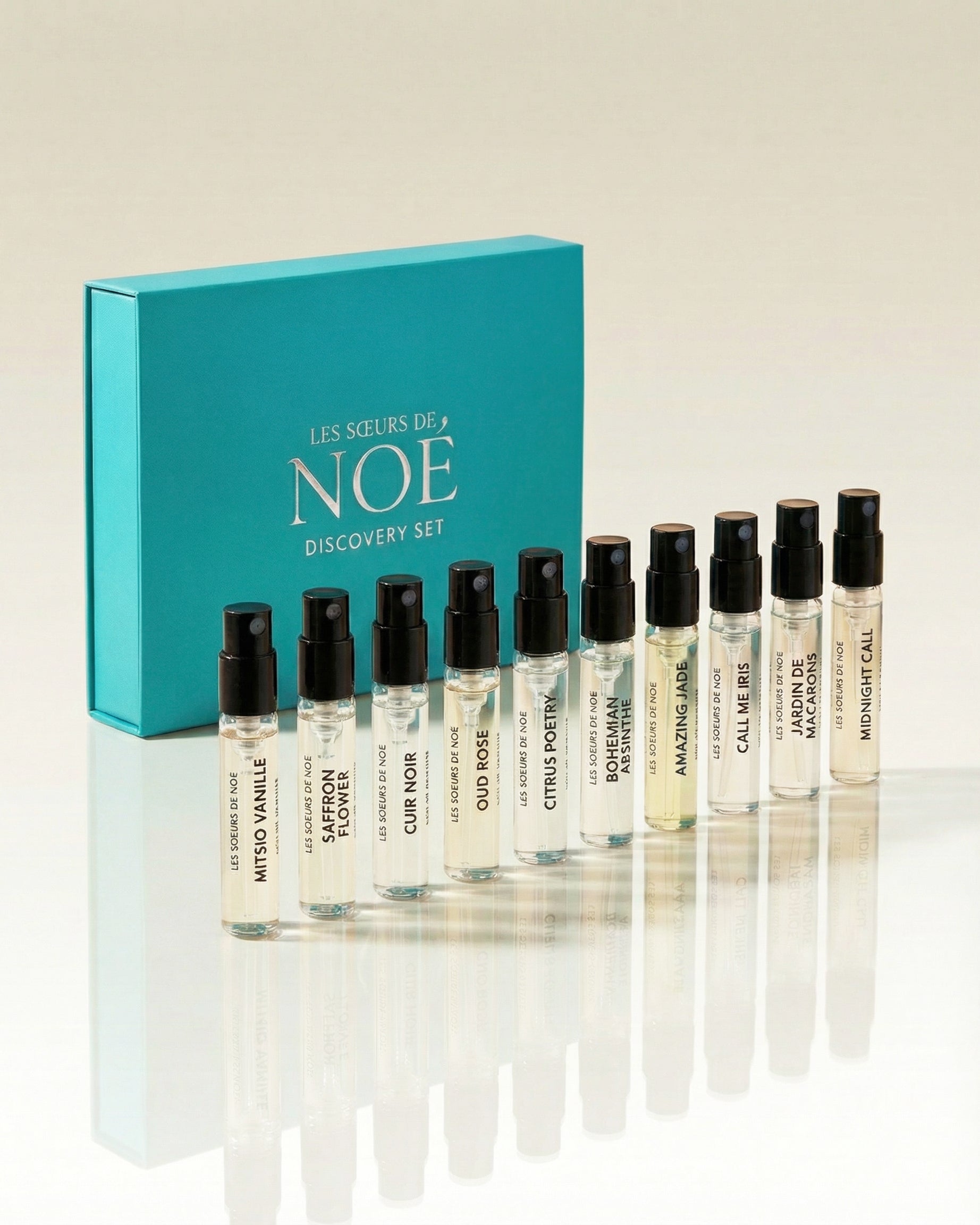
If you are beginning your wardrobe, our Discovery Set contains ten 2 ml fragrances from the Signature Collection, allowing you to experience different compositions at home before deciding what deserves a place in your collection.
If you already know which fragrances you want to compare, our Sample Box lets you create a personal selection of eight 2 ml samples.
The objective is not to make you choose faster.
It is to help you choose with more certainty.
Discover. Wear. Compare. Then decide.
The Best Perfume Wardrobe Is the One You Actually Wear
A perfume wardrobe does not need to be large.
It does not need to represent every fragrance family.
It does not need a daytime perfume, an evening perfume and four seasonal perfumes unless those categories genuinely matter to you.
It needs to give you choices you enjoy making.
Begin with what you already love.
Identify what is missing.
Test before committing.
Look for contrast rather than quantity.
And allow your wardrobe to change as your tastes change.
The strongest collection is not the one with the most bottles.
It is the one where every bottle gives you a reason to reach for it.
Frequently Asked Questions
What is a perfume wardrobe?
A perfume wardrobe is a curated selection of fragrances that you rotate according to factors such as mood, setting, season or personal preference. Unlike a perfume collection built mainly around ownership, a functional wardrobe gives each fragrance a role in your life.
How many perfumes should be in a perfume wardrobe?
There is no ideal number. A useful perfume wardrobe can contain three fragrances or many more. What matters is whether the fragrances give you meaningful choices rather than simply repeating the same experience.
How do I start building a perfume wardrobe?
Start with the fragrance you already enjoy wearing most. Then identify what experience is missing from it. Your next fragrance should ideally create contrast or fill a genuine gap rather than simply resemble something you already own.
Is it better to have one signature scent or several perfumes?
Neither is inherently better. Some people enjoy one signature perfume, while others prefer choosing fragrances according to mood, setting or season. A signature scent can also emerge naturally from a larger wardrobe as you notice which fragrance you repeatedly reach for.
Should I organise my perfume wardrobe by season?
Only if season genuinely affects what you enjoy wearing. Temperature and environment can influence fragrance perception, but you do not need a separate perfume for every season if your existing fragrances continue to work for you.
Should I have separate daytime and evening perfumes?
Not necessarily. Day and evening can be useful categories if you enjoy changing your fragrance, but they are not rules. The same perfume can be worn at different times if it feels right to you.
How can I avoid buying perfumes that are too similar?
Before buying, compare the new fragrance with what you already own. Ask what role it will play, when you would wear it and what experience it gives you that your existing perfumes do not.
Should I sample perfume before buying a full bottle?
Sampling is one of the most useful ways to understand how a fragrance develops on your skin and whether you genuinely want to keep wearing it. A first impression, note list or review cannot completely replace personal experience.
Is a Discovery Set useful for building a perfume wardrobe?
Yes. A Discovery Set allows you to compare several fragrances without immediately committing to full bottles. It can help you identify which olfactive directions you enjoy and which fragrances you repeatedly want to wear.
What fragrance should I buy first for my perfume wardrobe?
Begin with the perfume you can imagine wearing often in your real life. Rather than choosing according to a predetermined fragrance family, look for something you genuinely enjoy wearing repeatedly. Your second fragrance can then introduce contrast.


Leave a comment
This site is protected by hCaptcha and the hCaptcha Privacy Policy and Terms of Service apply.