

Finding your signature scent is not about choosing the most expensive perfume, following a trend or matching your personality to a list of fragrance notes.
It is about discovering the fragrance you genuinely want to return to.
A strong signature candidate usually does four things well: you enjoy smelling it, its presence feels comfortable, it fits naturally into your real life and you still want to wear it after the excitement of the first spray has faded.
You do not need to know every fragrance family.
You do not need to find one perfume for the rest of your life.
And you do not need someone else to tell you which fragrance is “you.”
The most useful question is simpler:
Which perfume do I keep wanting to wear again?
What Is a Signature Scent?
A signature scent is a fragrance you return to so naturally that it begins to feel familiar.
It may be the perfume you instinctively reach for when getting dressed.
The one you miss when the bottle is empty.
Or the scent someone close to you begins to associate with your presence.
A signature perfume does not have to be rare, expensive or especially powerful.
It does not need to receive compliments.
It does not even have to be the only perfume you wear.
What matters is the relationship you build with it.
A perfume you like creates interest. A signature scent creates return desire.
You do not simply think:
This smells good.
You begin to think:
I want to wear this again.
That difference is important.
How Do You Know Which Perfume Suits You?
There is no scientific test that can identify one perfume as objectively “right” for you.
But you can make the decision much easier by paying attention to four things.
We call this the Signature Fit Matrix.
| Dimension | Question to Ask |
|---|---|
| Attraction | Do I genuinely enjoy smelling this fragrance? |
| Presence | Does the way it wears around me feel comfortable? |
| Lifestyle Fit | Can I imagine naturally wearing it in my real life? |
| Return Desire | Do I actively want to wear it again? |
These four dimensions are more useful than trying to match fragrance notes to personality stereotypes.
A perfume may smell beautiful but feel too formal for your everyday life.
Another may sound perfect from its note list but never make you want to reach for it.
A third may surprise you at first and gradually become the fragrance you miss when you are not wearing it.
That is why choosing perfume is easier when you evaluate the experience rather than the description alone.
Step 1: Start With the Fragrances You Already Love
Before searching for something new, look at the fragrances you already enjoy.
Think about the perfumes you have actually worn most often.
Not necessarily the bottles you purchased most recently.
Think about:
-
the bottles you finished;
-
the samples you used first;
-
the fragrances you reached for without thinking;
-
the perfumes you missed when you stopped wearing them.
Then ask what those fragrances have in common.
Perhaps you repeatedly enjoy scents that feel:
-
bright and fresh;
-
juicy and fruity;
-
soft and floral;
-
smooth and woody;
-
warm and enveloping;
-
creamy and comforting;
-
clean and understated;
-
unusual but still wearable.
You may discover that your favourite perfumes share a feeling even when their listed notes are completely different.
That is often your first useful clue.
Look Beyond Individual Notes
A note list can help you understand the direction of a fragrance.
It cannot tell you exactly how the finished perfume will smell.
Two perfumes containing vanilla can feel completely different.
One may be airy and floral.
Another may feel creamy and warm.
Another may become dry and woody.
Pear can feel crisp, juicy or gourmand.
Iris can feel powdery, creamy, woody or cool.
Musk can feel clean, warm, soft or intimate.
So instead of deciding:
I am a vanilla person.
ask:
What do I actually love about the vanilla perfumes I enjoy?
The same principle applies to every fragrance note.
The note gives you a clue. The composition creates the experience.
Step 2: Identify Your Preference Pattern, Not Your “Perfume Personality”
It is tempting to search for rules such as:
confident people wear oud
romantic people wear rose
minimalists wear musk
These ideas can be entertaining, but they are not useful rules for choosing fragrance.
A better approach is to identify your preference pattern.
Presence
Which feels more natural to you?
Intimate and close ↔ noticeable and expressive
Some people enjoy perfume mainly within their personal space.
Others want a more noticeable presence.
Neither preference is better.
Texture
Which direction attracts you more?
Fresh and airy ↔ creamy and enveloping
Texture often tells you more about your taste than one individual ingredient.
Familiarity
Do you prefer:
recognisable and comforting ↔ unexpected and intriguing
Some people are happiest with immediately familiar fragrances.
Others need an element of surprise.
Many great signature scents sit somewhere in between.
Mood
What do you want fragrance to add to your day?
Energy?
Comfort?
Elegance?
Playfulness?
Sensuality?
Calm?
Confidence?
Fragrance does not have to describe who you are.
It can also influence how you want to feel.
Contrast
Do you want your perfume to reinforce your usual style?
Or do you enjoy fragrance precisely because it lets you explore another side of yourself?
A reserved person may love an expressive perfume.
Someone with a dramatic style may prefer a quiet skin scent.
There is no contradiction.
Step 3: Decide What Role Your Signature Scent Should Play
Before choosing the perfume, decide what you want it to do.
Imagine your actual life.
Not a perfume advertisement.
Where will you wear it?
At work?
At home?
While travelling?
At dinner?
On weekends?
Almost everywhere?
Some people want one fragrance that works naturally across many situations.
Others want a more distinctive perfume for specific moments.
Both approaches are valid.
Does a Signature Scent Need to Work Everywhere?
No.
A fragrance can be your signature without being appropriate for every environment or every mood.
You may have one fragrance you wear most of the time and another that feels more natural in the evening.
Or different fragrances may become associated with different seasons or parts of your life.
The goal is not to force one perfume to do every job.
The goal is to understand what role you actually want it to play.
Step 4: Build a Shortlist of Three
Once you understand your preferences, reduce the choice.
Start with three fragrances.
But choose them for different reasons.
1. The Familiar Choice
Choose one fragrance that feels close to a style you already know you enjoy.
This gives you a useful reference point.
2. The Curious Choice
Choose something that remains connected to your taste but introduces a new note, texture or contrast.
It should make you curious.
3. The Unexpected Choice
Choose one fragrance you might normally overlook.
Why?
Because what sounds most like you on paper is not always what you enjoy most when worn.
You may start searching for vanilla and become fascinated by iris.
You may expect to choose a fresh citrus fragrance and repeatedly return to a fruity perfume with a warm base.
The shortlist is not designed to prove your assumptions correct.
It is designed to test them.
Four Contrasting Fragrance Directions to Explore
To make these differences concrete, here are four very different directions within Les Soeurs de Noe.
They are examples, not personality categories.
Bright and Luminous: Citrus Poetry
Citrus Poetry combines lemon, ginger and black pepper with apple, orange, jasmine, amber and moss.
It is useful to explore if you are attracted to brightness, freshness and energy.
The lesson is not simply “citrus equals fresh.”
It shows how citrus can be given more texture through spice, florals and a deeper base.
Juicy With Warmth: Pear Addiction
Pear Addiction opens with pear, apple and lychee before violet and jasmine lead toward white cedarwood, pink musks and amber.
It can be interesting if you love fruity perfumes but do not necessarily want them to remain purely fresh or playful.
It illustrates how fruit can become warmer and more sensual as a fragrance develops.
Refined and Textured: Call Me Iris
Call Me Iris combines bergamot, lemon and pink pepper with iris, incense, vanilla and fir balsam.
It is a useful example of why a single note rarely tells the complete story.
Iris can feel powdery, but the surrounding composition can also make it feel fresh, warm, textured or contrasting.
Soft and Enveloping: Mitsio Vanille
Mitsio Vanille combines bergamot, white freesia and ambrette with vanilla orchid, lilac, vanilla, musks and driftwoods.
It demonstrates how vanilla does not have to mean simple sweetness.
A vanilla fragrance can also feel floral, textured and enveloping.
The purpose of comparing these directions is not to identify “your category.”
It is to notice which experience makes you curious enough to keep exploring.
How to Use a Discovery Set Without Overwhelming Yourself
A wider fragrance selection gives you range.
Your shortlist gives you focus.
Your Discovery Set gives you the range. Your shortlist gives you the focus.
If you begin with several samples, you do not need to compare all of them intensively at the same time.
Start by discovering broadly.
Notice which fragrances immediately interest you.
Then reduce the selection to three favourites.
Those are the ones worth wearing repeatedly.
This turns sampling into a decision process rather than a collection of first impressions.
Step 5: Wear Your Shortlist in Real Life
Descriptions help you choose what to try.
Wearing the perfume helps you decide what to keep.
Try each shortlisted fragrance on a separate day when possible.
Then revisit your favourites.
Notice:
-
whether you enjoy the opening;
-
how the fragrance changes as you wear it;
-
whether its presence feels comfortable;
-
whether it works naturally in your environment;
-
whether you enjoy catching it on yourself later;
-
whether you want to wear it again.
You do not need to analyse every note.
You are looking for your own reaction.
A fragrance quiz can help you decide where to start.
Repeated wear helps you decide what to keep.
For a more detailed testing process, read How to Test Perfume Like an Expert.

The Signature Scent Comparison Sheet
If several fragrances appeal to you, compare them after more than one wear.
| Question | First Wear | Another Wear |
|---|---|---|
| What did I genuinely enjoy? | ||
| Did its presence feel comfortable? | ||
| Where could I naturally wear it? | ||
| Did I enjoy what it became after the opening? | ||
| Did I want to wear it again? |
Do not calculate a score.
The purpose is not to turn fragrance into mathematics.
The value comes from seeing whether your reaction stays consistent.
Sometimes the fragrance that creates the strongest first impression loses its appeal later.
Another may become more interesting with every wear.
That difference matters.
The Return Test
After wearing your shortlist more than once, ask five questions.
-
Do I think about this fragrance when I am not wearing it?
-
Do I choose it when other samples are available?
-
Do I enjoy it on an ordinary day, not only in a special setting?
-
Do I still want it after the novelty of the first wear has disappeared?
-
Would I miss it if the sample were empty?
You do not need five perfect yeses.
Look for the pattern.
The strongest signature candidate is often not the perfume that made the loudest first impression.
It is the fragrance you keep coming back to.
What Is the Difference Between a Favourite Perfume and a Signature Scent?
They can be the same fragrance.
But they do not have to be.
Your favourite perfume might be something you find extraordinary but only want to wear occasionally.
A signature scent usually has a stronger relationship with repetition.
You do not only admire it.
You actually use it.
That distinction becomes especially useful when deciding whether to buy a full bottle.
Does Your Signature Scent Need to Be Unique?
No.
A perfume does not become less personal because other people wear it.
Likewise, an unusual fragrance is not automatically a better signature.
Rarity can create curiosity.
But what matters more is whether the fragrance feels compelling enough to interest you and comfortable enough to become part of your life.
A signature scent becomes personal through your relationship with it.
Not through exclusivity alone.
Should You Choose a Signature Scent Based on Compliments?
Compliments can be enjoyable.
They can tell you that someone else noticed and appreciated your fragrance.
But they cannot tell you whether you should keep wearing it.
A signature perfume spends far more time with you than with the people around you.
Ask yourself:
Would I still want to wear this perfume if nobody commented on it?
If the answer is yes, you have a stronger reason to keep it.
For more on this subject, read Why Some Perfumes Attract More Compliments Than Others.
Can You Have More Than One Signature Scent?
Yes.
Some people enjoy one fragrance for years.
Others naturally rotate several perfumes.
You might have:
-
an everyday signature;
-
a fragrance you associate with evenings;
-
one that feels particularly natural in colder or warmer weather;
-
a perfume linked to a certain period of your life.
Your taste can also evolve.
A signature scent is not a lifetime contract.
It describes a relationship you have with fragrance now.
If you enjoy having several complementary options, read How to Build a Perfume Wardrobe.
How to Find Your Signature Scent Without Buying the Wrong Bottle
A full-size bottle is easier to justify when you already know you want more of the perfume.
That is why discovery works best in stages.
1. Understand
Identify the sensations and fragrance directions that interest you.
2. Explore
Smell several possibilities rather than committing immediately.
3. Shortlist
Reduce the options to a few strong candidates.
4. Wear
Experience them during real life rather than only on a blotter.
5. Return
Notice which fragrance you repeatedly want to choose again.
Then decide.
The journey should feel like:
curious → familiar → wanted
rather than:
description → full bottle

Discovery Set or Sample Box: Which Should You Choose?
At Les Soeurs de Noe, the two options solve different problems.
Discovery Set: When You Want to Explore
10 × 2 ml - €55
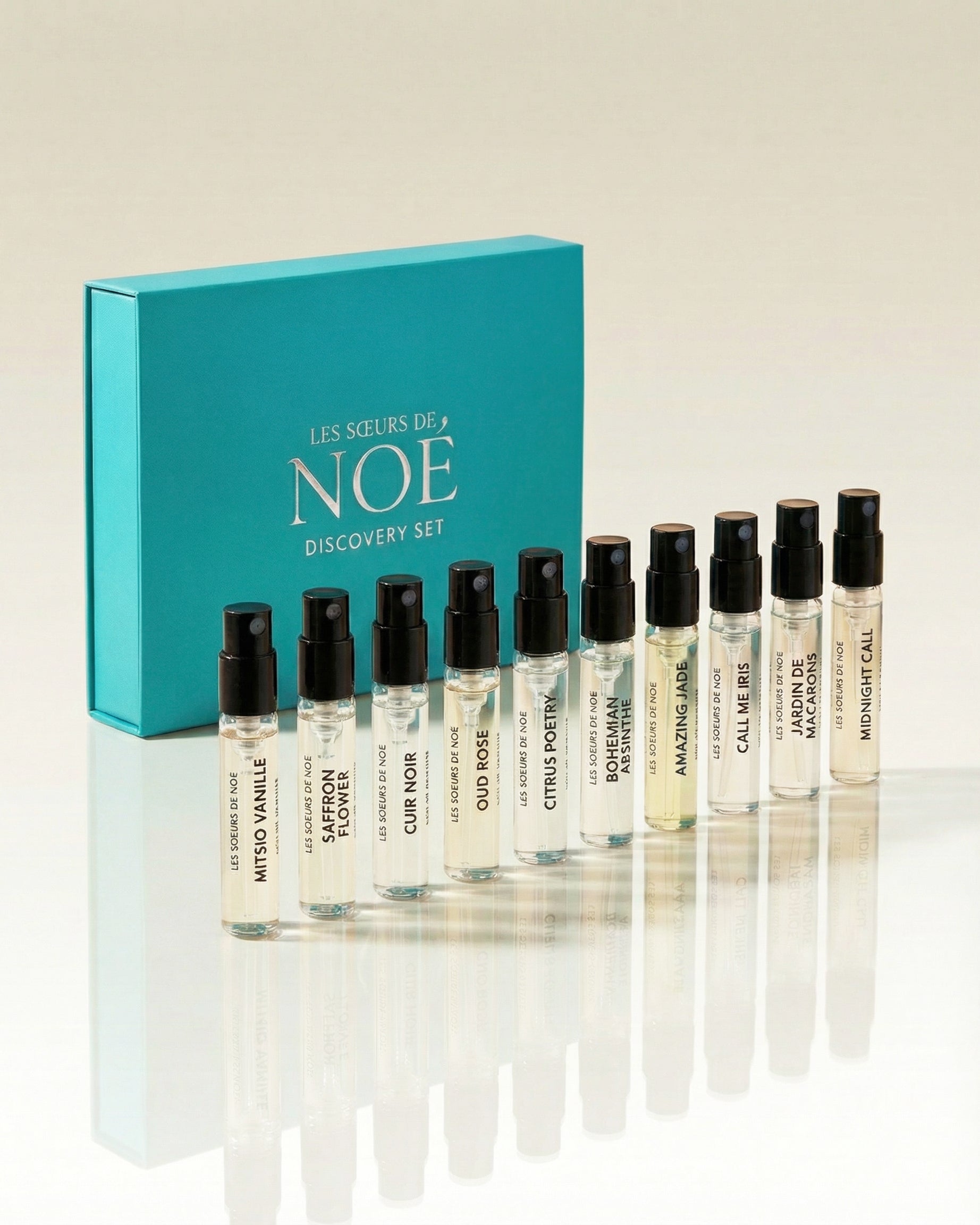
The Discovery Set introduces you to ten fragrances from the Signature Collection.
It is useful when you want to explore a wider range before deciding which fragrance directions appeal to you most.
The set includes a €50 voucher toward an eligible order over €150.
Sample Box: When You Already Have a Shortlist
8 × 2 ml - €50
The Sample Box lets you build your own selection of eight fragrances.
It is particularly useful if you already know which fragrances, notes or collections you want to compare.
Start with your three strongest candidates.
Use the remaining choices to explore neighbouring styles or something deliberately different.
The Sample Box also includes a €50 voucher toward an eligible order over €150.
Discovery Set = What do I like?
Sample Box = Which of these do I want?
For a deeper comparison, read Why Discovery Sets Are the Smartest Way to Buy Perfume.
What If None of the Perfumes Feels Right?
Do not force the decision.
Sampling is useful even when it does not immediately lead to a full bottle.
Learning:
I do not actually enjoy this type of fragrance
is useful information.
So is:
I thought I wanted vanilla, but I keep choosing something fruity.
Every comparison makes your preferences clearer.
A signature scent is not something you need to find quickly.
It is something you recognise through experience.
The Les Soeurs de Noe Approach to Finding a Signature Scent
At Les Soeurs de Noe, we do not believe a fragrance needs to match a predefined personality type.
We prefer a slower approach:
attraction → real-life wear → comparison → return desire.
Our fragrances are made in France and created to be explored according to personal attraction rather than traditional gender categories.
The point is not to tell you which perfume should represent you.
It is to give you enough space to discover which one you naturally want to make your own.
There is no reason to force a full-bottle decision.
Your Signature Scent Is the Perfume You Keep Choosing
You do not need a perfect nose to find your signature scent.
You need attention.
Start with what you already love.
Look for patterns in the experiences you enjoy.
Choose a few different candidates.
Wear them.
Compare them.
Then observe your behaviour.
Which fragrance do you keep reaching for?
Which one do you think about when you are not wearing it?
Which sample makes you wish there were more left?
That is where a signature scent usually begins.
Not with a personality label.
Not with a trend.
Not with somebody else's list of the “best perfumes.”
With the desire to return.
Frequently Asked Questions
How do I find my signature scent?
Start by identifying fragrances you already enjoy and the sensations they share. Build a shortlist of a few different candidates, wear each on your skin in real life and notice which fragrance you repeatedly want to wear again.
What perfume suits my personality?
There is no reliable rule connecting personality traits with specific perfume notes or fragrance families. Instead, consider your preferences for presence, texture, familiarity, mood and contrast, then test fragrances that express those qualities differently.
How do I know which perfume suits me?
A perfume is more likely to suit you when you enjoy it beyond the opening, its presence feels comfortable, you can imagine naturally wearing it in your life and you keep wanting to return to it.
Can I have more than one signature scent?
Yes. You may have one main fragrance or several signatures linked to different moods, seasons, occasions or periods of your life.
Should I test perfume on my skin before buying?
Whenever possible, yes. A blotter can introduce the fragrance, but wearing it helps you understand how you experience the scent over time and whether you genuinely enjoy living with it.
How many perfumes should I try before choosing a signature scent?
There is no required number. A shortlist of three contrasting but appealing fragrances can make comparison easier, but you can explore more if none of them feels right.
Is a Discovery Set or Sample Box better for finding a signature scent?
Choose a Discovery Set when you want broad exploration. Choose a customizable Sample Box when you already know several fragrances you want to compare directly.
How do I know when a perfume is worth buying in full size?
A full bottle becomes easier to justify when you already enjoy wearing the fragrance repeatedly, appreciate how it develops and feel disappointed when your sample begins to run out.


Leave a comment
This site is protected by hCaptcha and the hCaptcha Privacy Policy and Terms of Service apply.