

Fresh. Floral. Woody. Amber. Gourmand.
Fragrance vocabulary can make choosing perfume feel more complicated than it needs to be.
You may know instantly that you love a fragrance, yet struggle to explain why.
Or you may read a list of notes, bergamot, iris, cedarwood, vanilla, and still have no idea whether the finished perfume will actually feel like you.
That is where fragrance families become useful.
A fragrance family gives you a broad sense of a perfume's overall character.
It is not a rule.
It is not a personality test.
And it cannot tell you whether you will love a perfume.
But once you recognize the scent profiles you naturally return to, discovering fragrance becomes much easier.
Here is how.
What Is a Fragrance Family?
A fragrance family is a way of grouping perfumes that share a recognizable olfactive character.
Think of it as a broad direction rather than a precise formula.
Two perfumes might both belong to the floral family while smelling completely different.
One could feel luminous and airy.
Another rich, creamy and enveloping.
The family helps describe their common territory.
The individual composition gives each fragrance its personality.
That distinction matters because fragrance families are designed to help you navigate perfume, not restrict your choices.
Fragrance Family vs Fragrance Note: What's the Difference?
These two terms are often confused.
A note describes an ingredient, accord or olfactive impression you may perceive within a perfume.
Examples include:
- pear
- jasmine
- vanilla
- iris
- cedarwood
- bergamot
A fragrance family describes the broader character of the composition.
For example, a perfume containing vanilla does not automatically belong to one specific family.
Vanilla can appear in something gourmand, floral, woody, amber or even surprisingly fresh.
The same is true of rose, citrus, musk and most other materials.
Notes tell you what may be inside the composition.
Families help describe how the composition feels as a whole.
That is why reading only the note list can sometimes be misleading when shopping for perfume.
What Are the Main Fragrance Families?
There is no single classification system used identically by every perfume house, retailer or fragrance expert.
But a simplified map commonly includes four broad territories:
Fresh, Floral, Woody and Amber.
Around and between them sit many other useful descriptions: fruity, aromatic, gourmand, musky, green, aquatic and more.
The boundaries overlap.
And that is exactly what makes perfume interesting.
1. Fresh Fragrances
Fresh fragrances often create a sense of brightness, clarity or energy.
You may encounter:
- citrus
- aromatic herbs
- green notes
- aquatic or marine impressions
- crisp fruits
Think lemon peel.
Bergamot.
Fresh herbs.
Green leaves.
Cool air.
Fresh does not necessarily mean simple or short-lived.
And a fresh fragrance does not have to smell like traditional cologne.
Modern perfumers can combine freshness with woods, musks, flowers, spices or amber materials to create much more complex compositions.
You may enjoy fresh fragrances if...
You repeatedly gravitate toward scents that feel:
bright, crisp, transparent, energetic or easy to wear.
If citrus is one of the directions you naturally love, Citrus Poetry is one way to explore that territory through the Les Soeurs de Noé collection.
2. Floral Fragrances
Floral is one of the broadest fragrance families.
A floral perfume might centre around:
- rose
- jasmine
- iris
- tuberose
- orange blossom
- violet
- lily of the valley
But “floral” tells you surprisingly little on its own.
A rose can feel fresh.
Dark.
Fruity.
Spicy.
Powdery.
Woody.
An iris composition can feel soft and elegant or cool and architectural.
A white floral can be luminous or intensely enveloping.
This is why it is more useful to ask:
What kind of floral do I enjoy?
rather than simply:
Do I like floral perfume?
If iris interests you, Call Me Iris offers one interpretation to explore.
3. Woody Fragrances
Woody fragrances build their character around materials and accords that evoke wood, earth, dryness or warmth.
Common references include:
- cedarwood
- sandalwood
- vetiver
- patchouli
- oud
But woody does not automatically mean dark or heavy.
A woody fragrance can feel:
dry and minimal
smooth and creamy
fresh and aromatic
warm and enveloping
smoky and mysterious
Woods are also frequently used underneath other families, giving structure to floral, fruity or fresh compositions.
If you repeatedly enjoy the drydown of perfumes more than their opening, you may discover that woody notes are one of the threads connecting your favourites.
4. Amber Fragrances
Amber fragrances generally explore warmth.
Rather than referring to one specific ingredient, “amber” often describes a style created through combinations of materials such as:
- vanilla
- resins
- balsamic notes
- spices
- woods
- musks
They can feel soft and comforting or deep and sensual.
Some fragrance references traditionally use the term Oriental for parts of this olfactive territory, while many contemporary classifications now use Amber instead.
You may encounter both terms when reading about perfume.
The useful question is not which label is theoretically perfect.
It is whether you enjoy the warm, resinous or enveloping character it describes.
Where Do Fruity and Gourmand Fragrances Fit?
This is where rigid classifications become less useful.
Fruity fragrances
Pear, apple, peach, cherry, berries and other fruit impressions can appear across many different compositions.
A fruity perfume can become floral.
Woody.
Fresh.
Musky.
Or gourmand.
For example, Pear Addiction begins with a fruity direction but develops through florals, woods, musks and amber.
That complete journey tells you much more than the word “pear” alone.
Gourmand fragrances
Gourmand perfumes use notes or accords that evoke edible sensations.
Think:
vanilla
caramel
cocoa
coffee
praline
creamy or dessert-like textures
But even gourmand is not one fixed smell.
Vanilla can be sugary.
Dry.
Floral.
Woody.
Musky.
Or barely sweet at all.
If vanilla is something you naturally return to, our guide to Vanilla Perfume: Everything You Need to Know explores this distinction in greater depth.

Most Perfumes Belong to More Than One World
This is perhaps the most important thing to understand about fragrance families.
You do not have to put every perfume into one perfect box.
A composition might reasonably be described as:
floral woody
fruity floral
amber woody
aromatic fresh
floral gourmand
Different sources may even classify the same perfume slightly differently.
That does not mean one of them is necessarily wrong.
Fragrance classification is a tool for communication.
It is not the perfume itself.
The interesting part is often exactly where the categories meet.
How to Find the Fragrance Families You Love
You do not need to study a fragrance wheel until you can recite every category.
Start with your own experience.
Step 1: Look at the Perfumes You Already Wear
Think about three fragrances you have genuinely enjoyed.
Not necessarily the ones that received the most compliments.
The ones you wanted to wear.
Look at their descriptions and ask:
What words keep appearing?
Citrus?
White florals?
Vanilla?
Woods?
Musk?
Fruit?
You may start seeing a pattern.
Step 2: Identify the Feeling, Not Just the Ingredient
Suppose three of your favourite perfumes contain vanilla.
That does not necessarily mean:
“I like vanilla.”
Ask what kind of vanilla you enjoy.
Creamy?
Floral?
Warm?
Dry?
Sweet?
Musky?
Now you are getting much closer to your actual preference.
Do the same with other notes.
Instead of:
“I like citrus.”
Try:
“I like bright citrus fragrances that become warm on the skin.”
That description is far more useful when discovering something new.
Step 3: Explore a Neighbouring Family
Once you know what feels familiar, move slightly outside it.
If you love fresh citrus, try something fresh with woods.
If you love fruity compositions, explore fruity florals.
If you love vanilla, compare a gourmand vanilla with a floral interpretation.
If you love flowers, explore how they change when paired with amber or woods.
This allows you to expand your taste without choosing completely at random.
Step 4: Try One Fragrance You Would Normally Ignore
This one matters.
The fragrance you think you should like is not always the fragrance you end up loving.
Sometimes the unexpected sample becomes the one you keep returning to.
That is why discovery works better when it includes both familiarity and curiosity.
Do Fragrance Families Tell You How Long a Perfume Will Last?
No.
A family can help describe the scent profile.
It does not guarantee performance.
A woody perfume is not automatically long-lasting.
A citrus fragrance is not automatically fleeting.
An amber fragrance is not automatically powerful.
Longevity, projection and sillage depend on the complete formula and the way you experience it.
If performance matters to you, our guide to Perfume Concentration Explained: EDP, EDT and More explains why concentration and fragrance family should not be confused.
Can You Love More Than One Fragrance Family?
Absolutely.
In fact, most people do.
You may love something bright and citrusy during one period of your life and find yourself drawn toward woods later.
You may wear florals during the day and warmer fragrances at night.
Or your favourites may sit between several categories.
Your preferences do not need to remain consistent to be real.
Perfume is not a test where you have to discover your one correct family.
The goal is to develop a vocabulary for what attracts you.
Once you have that vocabulary, exploring becomes easier.

From Fragrance Family to Signature Scent
Knowing your preferred families helps you narrow the field.
But it should not make the final decision for you.
You might discover that:
“I love fresh woody fragrances.”
Excellent.
You have reduced hundreds of options to a much more useful direction.
Now comes the part no classification system can do for you:
wear the perfume.
Experience how it develops.
Notice whether you enjoy returning to it.
And compare it with something slightly different.
If you are ready to move from identifying your preferences to choosing a fragrance, read How to Find Your Signature Scent: A 5-Step Guide.
If you are using fragrance families to choose for someone else, they can also help you build a more thoughtful shortlist. Our perfume gift guide shows how to turn that direction into the right gift, from a full bottle to a discovery format.

The Best Way to Understand Fragrance Families Is to Smell Them
Reading helps.
Experience teaches faster.
Put a bright fragrance beside a warm one.
Compare a floral composition with something woody.
Try two fragrances that both contain vanilla and notice how differently they interpret it.
At Les Soeurs de Noé, there are two ways to do that before deciding on a full bottle.
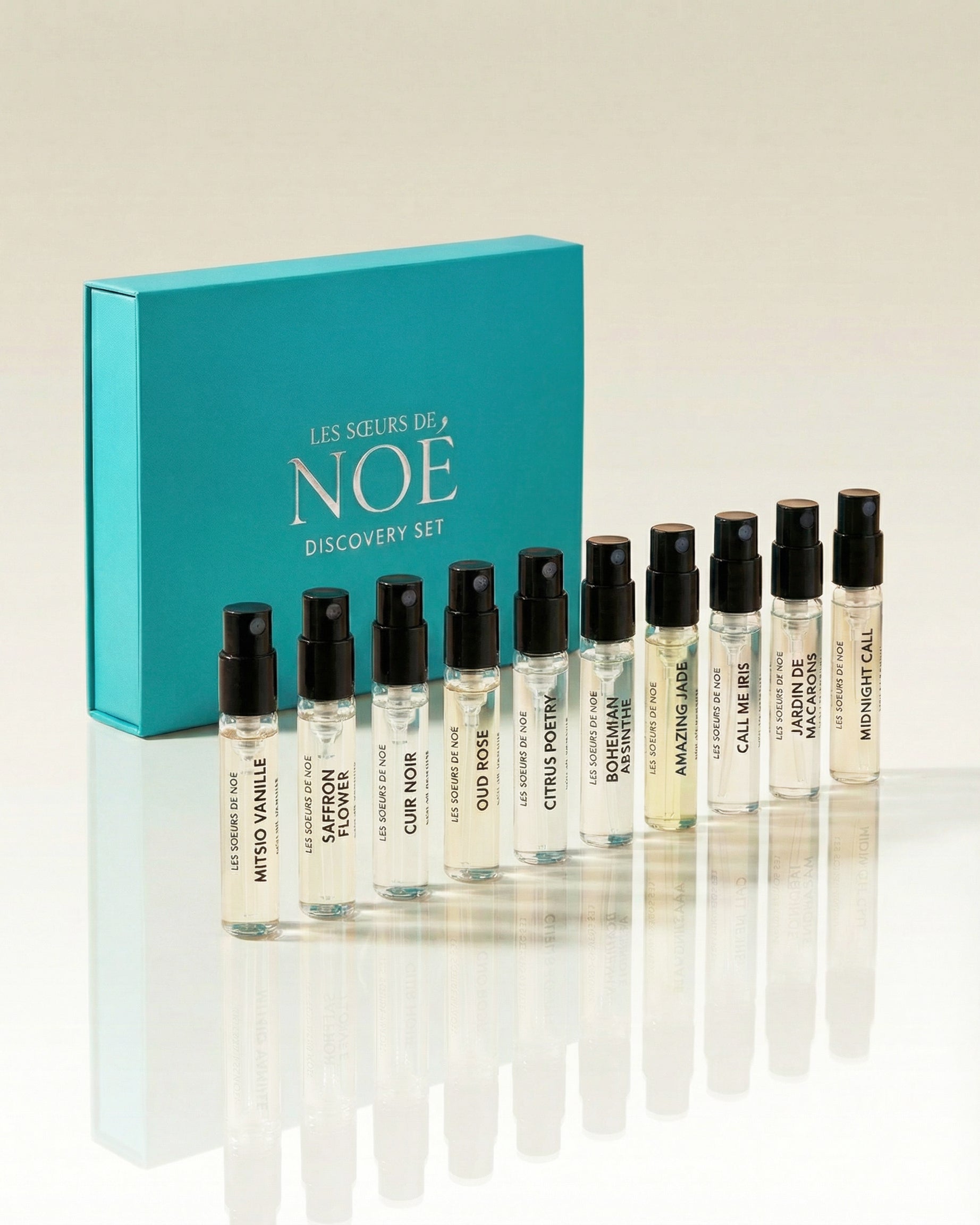
Discovery Set
10 × 2 ml — €55
Explore ten fragrances from the Signature Collection and begin identifying the olfactive directions you naturally return to.
The Discovery Set includes a €50 voucher toward an eligible order over €150.
Sample Box
8 × 2 ml - €50
If you already know some of the fragrances or profiles you want to compare, create your own selection of eight samples.
The Sample Box also includes a €50 voucher toward an eligible order over €150.
Wear them at home.
Compare them.
Notice the similarities.
Notice the surprises.
And pay attention to the ones you keep wanting to wear.
For more guidance on evaluating fragrance on your own skin, read How to Test Perfume Like an Expert.
Fragrance Families Are a Map, Not a Rulebook
Understanding fragrance families gives you something valuable:
a language for your own taste.
Instead of saying:
“I don't know what perfume I like.”
you may begin to say:
“I love bright citrus fragrances with a warmer base.”
or:
“I thought I liked sweet vanilla, but I actually prefer it when it feels floral and soft.”
or:
“I keep coming back to woody drydowns.”
That is when perfume becomes easier to navigate.
Use fragrance families to point you in a direction.
Use notes to understand the composition.
Use samples to experience it for yourself.
And ultimately:
choose the fragrance you want to wear again.
Frequently Asked Questions
What are the main fragrance families?
A simplified fragrance-family system often groups perfumes into Fresh, Floral, Woody and Amber territories, with many additional categories and sub-families such as fruity, gourmand, aromatic, green and musky. Classification systems vary, so these categories are best used as guides rather than absolute rules.
What is the difference between a fragrance family and a perfume note?
A note describes an individual ingredient, accord or olfactive impression such as rose, vanilla or cedarwood. A fragrance family describes the broader character of the complete composition.
How do I know which fragrance family I like?
Look at several fragrances you genuinely enjoy and identify recurring characteristics in their descriptions. Then compare samples from similar and neighbouring families to see which profiles you repeatedly want to wear.
Can I like more than one fragrance family?
Yes. Many people enjoy several fragrance families, and preferences may change according to mood, season, occasion or simply over time.
Is gourmand a fragrance family?
Gourmand is widely used to describe fragrances with edible or dessert-like characteristics. Depending on the classification system, it may be treated as a family, sub-family or descriptive style.
Does fragrance family determine longevity?
No. Fragrance family alone does not determine longevity, projection or sillage. Those characteristics depend on the complete composition, concentration, materials and other factors.
Is Amber the same as Oriental perfume?
You may encounter both terms. Many contemporary fragrance sources use Amber for olfactive territory historically described as Oriental, particularly for warm, resinous and spicy compositions. Classification terminology is not completely universal.
Do certain fragrance families belong to men or women?
No. Fragrance families do not inherently belong to a gender. Fresh, floral, woody, amber and gourmand compositions can be enjoyed by anyone.
Should I choose perfume by fragrance family or by notes?
Use both as clues. Families help you understand the overall direction, while notes reveal parts of the composition. Neither replaces actually smelling and wearing the fragrance.


Leave a comment
This site is protected by hCaptcha and the hCaptcha Privacy Policy and Terms of Service apply.