

Perfume concentration tells you how much fragrance concentrate is present in the finished perfume.
It does not tell you, by itself, whether a fragrance is better, stronger or longer-lasting.
Eau de Cologne, Eau de Toilette, Eau de Parfum and Parfum or Extrait are commonly used concentration categories, but their percentage ranges overlap and are not universal standards.
The useful question is therefore not simply:
Which concentration is strongest?
It is:
Which fragrance gives me the wearing experience I actually want?
This guide explains the main perfume concentration levels, what EDP and EDT really mean, how concentration can affect performance, and what to look at before choosing your next perfume.
What Does Perfume Concentration Actually Mean?
Perfume concentration refers to the proportion of fragrance concentrate in the finished fragrance.
That concentrate is the perfumer’s composition: a carefully balanced blend of aromatic materials that may include both natural ingredients and synthetic molecules.
It is typically combined with alcohol and, depending on the formulation, other components such as water.
For example, a fragrance formulated at 20% concentration contains approximately 20% fragrance concentrate in the finished product.
But this percentage should be read as technical information, not as a prediction of the entire wearing experience.
It does not tell you exactly how the perfume will smell, how far it will project, how long it will remain perceptible or whether you will prefer it to a fragrance at a different concentration.
Those qualities depend on the complete formula, the materials used and the way the fragrance has been composed.
Concentration tells you how much fragrance concentrate is present. It does not tell you how good the perfume is.
Eau de Toilette vs Eau de Parfum vs Extrait: What's the Difference?
Perfumes are commonly grouped into concentration categories such as Eau de Cologne, Eau de Toilette, Eau de Parfum and Extrait de Parfum.
These categories are useful, but they should be understood as reference points rather than fixed rules.
| Fragrance type | Typical concentration | What it usually indicates |
|---|---|---|
| Eau de Cologne (EDC) | 3–8% | A lower concentration format |
| Eau de Toilette (EDT) | 5–15% | Generally less concentrated than EDP |
| Eau de Parfum (EDP) | 10–20% | Generally more concentrated than EDT |
| Extrait de Parfum / Parfum | 15–40% | Usually among the highest concentration formats |
These ranges are approximate industry conventions, not universal standards.
They overlap, and fragrance houses may use the terms differently.
That means the category can help you understand how a perfume is formulated, but it cannot tell you exactly how the perfume will smell, project or wear on skin.
Eau de Cologne (EDC)
Eau de Cologne is traditionally associated with lower fragrance concentrations and is often linked with fresh, citrus or aromatic styles.
But the name describes a concentration category, not a fixed olfactive personality.
An Eau de Cologne does not have to smell the same from one fragrance to another.
Eau de Toilette (EDT)
Eau de Toilette generally contains a lower proportion of fragrance concentrate than Eau de Parfum.
It may feel lighter or more transparent, but that is not guaranteed.
An EDT can still be expressive, distinctive and long-lasting depending on the composition.
Eau de Parfum (EDP)
Eau de Parfum generally contains more fragrance concentrate than Eau de Toilette.
That makes it a higher concentration category, but it does not automatically mean stronger projection or better performance.
An EDP can feel fresh, subtle, radiant, rich or enveloping depending on how it has been composed.
Extrait de Parfum / Parfum
Extrait de Parfum, also called Parfum or perfume extract, is generally associated with higher fragrance concentrations.
Some extraits feel dense and intimate. Others can feel expansive and diffusive.
A higher concentration creates different formulation possibilities, but it does not automatically make an Extrait better than an Eau de Parfum.
The concentration category tells you how the fragrance is formulated. It does not tell you which version you will prefer.
Does a Higher Perfume Concentration Mean a Stronger Smell?
Not necessarily.
This is one of the most important distinctions to understand before buying perfume.
A fragrance can have a high concentration and still remain relatively close to the skin.
Another fragrance, formulated at a lower concentration, can create a more immediately noticeable impression.
Why?
Because concentration is only one part of performance.
Different aromatic materials evaporate and diffuse differently. The way they are combined influences how quickly a fragrance develops, how far it projects and how it is perceived around the wearer.
Increasing the percentage of fragrance concentrate does not automatically make every note equally stronger.
It does not necessarily create more projection.
And it does not automatically make the perfume better balanced.
More concentrate does not automatically mean more presence.
Does Eau de Parfum Last Longer Than Eau de Toilette?
Sometimes.
But not always.
A higher fragrance concentration can influence longevity, yet there is no universal formula that converts concentration into hours of wear.
An Eau de Parfum is not guaranteed to last eight hours.
An Eau de Toilette is not guaranteed to disappear after four.
The complete composition plays an essential role.
A fragrance built around bright, more volatile materials can behave differently from one featuring longer-lasting woody, musky or amber materials.
Temperature, environment, application and individual perception can also affect the wearing experience.
That is why choosing a perfume based only on a promised number of hours can be misleading.
A more useful question is:
Do I enjoy how this fragrance smells throughout the time I wear it?
If you want to evaluate the complete wearing experience rather than rely on first impressions alone, read our guide to How to Test Perfume Like an Expert.
Longevity, Projection and Sillage: Three Different Things
These terms are often used as though they mean the same thing.
They do not.
| Term | What it means |
|---|---|
| Longevity | How long the fragrance remains perceptible |
| Projection | How far the fragrance is noticeable from the wearer |
| Sillage | The scent trail a fragrance leaves as someone moves |
A perfume can remain perceptible for a long time while staying relatively close to the skin.
Another can create a very noticeable opening before becoming much more intimate.
Neither experience is automatically superior.
Some people want a fragrance that announces its presence.
Others prefer something that is discovered only when someone moves closer.
Long-lasting does not necessarily mean loud. Loud does not necessarily mean long-lasting.
The right performance is the performance you enjoy.
Can the Same Perfume Smell Different in EDT and EDP?
Yes.
And this is where fragrance concentration becomes particularly interesting.
When a fragrance house offers an Eau de Toilette and an Eau de Parfum under the same name, the difference may go beyond adding more or less fragrance concentrate.
The perfumer may adjust the composition itself.
Certain facets can become more prominent.
The heart or base may be rebalanced.
Some materials may appear more clearly while others become more discreet.
As a result, an EDT and an EDP can share the same recognizable identity while creating noticeably different olfactive experiences.
Do not assume that the EDP is simply a stronger version of the EDT.
If both versions are available, smell both.
The version you prefer may not be the one with the higher concentration.
Why Is a 25% Eau de Parfum Not Automatically an Extrait?
Because fragrance categories are conventions rather than universally fixed concentration thresholds.
A perfume house can formulate an Eau de Parfum above a commonly quoted EDP range while retaining the Eau de Parfum designation.
The percentage describes the proportion of fragrance concentrate in the finished product.
The designation, Eau de Toilette, Eau de Parfum, Parfum or Extrait, describes how the fragrance house categorizes the finished creation.
These two pieces of information are related.
They are not identical.
This distinction becomes particularly useful when exploring high-concentration niche perfumery.
A fragrance labelled Eau de Parfum at 25% is not necessarily incorrectly classified.
Nor does the percentage mean that it will behave exactly like another house's Extrait at the same concentration.
Two perfumes can share the same percentage and deliver completely different experiences.

What Perfume Concentration Can and Cannot Tell You
Perfume concentration is useful information.
But it becomes misleading when it is treated as a shortcut for everything else.
| Concentration can help tell you… | Concentration cannot tell you… |
|---|---|
| How much fragrance concentrate is used | Whether you will love the perfume |
| Which concentration category the fragrance belongs to | Exactly how many hours it will last |
| How two formats may differ technically | How far it will project |
| One element of the perfume's formulation | Whether the ingredients are better |
| Useful context when comparing fragrances | Whether the perfume is worth buying for you |
That distinction matters because perfume is not experienced as a percentage.
It is experienced on skin.
A Real-World Example: How Les Soeurs de Noe Uses Concentration
At Les Soeurs de Noe, concentration is a deliberate formulation choice.
Our Eau de Parfums are created at concentrations ranging from 20% to 25%, depending on the collection.
| Collection | Fragrance concentration |
|---|---|
| Signature Collection | 20% |
| Gold Collection | 25% |
| Ruby Collection | 25% |
This is a useful example of why concentration should not be read as a strict hierarchy.
Our Signature Collection is formulated at 20%, while the Gold and Ruby Collections are formulated at 25%.
Yet percentage alone does not describe how each fragrance smells, projects or develops.
A luminous fragrance and a warmer, more enveloping composition can offer very different experiences even when formulated at similar concentrations.
The number describes part of the formula.
The fragrance creates the experience.
Does Higher Concentration Mean Better Ingredients?
No.
Concentration and ingredient quality are separate questions.
A perfume formulated at 25% does not automatically contain better materials than one formulated at 15%.
Likewise, a higher percentage does not tell you whether the ingredients are natural or synthetic.
Both natural ingredients and synthetic molecules can play important roles in fine perfumery.
What matters is their selection, quality, balance and use within the complete composition.
At Les Soeurs de Noe, our fragrances are made in France, vegan and cruelty-free, with more than 85% ingredients of natural origin.
These choices reflect our approach to fragrance creation.
They are not a claim that natural ingredients are universally superior to synthetic ones.
A beautiful perfume is defined by the composition, not by a single number on its label.
Is a More Concentrated Perfume Better Value for Money?
Not automatically.
It may be tempting to assume that buying the highest concentration gives you more value.
But perfume is not simply purchased by the percentage of fragrance concentrate it contains.
You are also paying for the composition, the creative work, manufacturing, packaging and the overall product experience.
And most importantly, you are paying for something you hope to enjoy wearing.
A high-concentration fragrance that does not suit your taste is not a better purchase.
A lower-concentration fragrance that you love and wear regularly may feel far more worthwhile.
When evaluating value, ask yourself:
Would I still choose this fragrance if I knew nothing about its concentration?
That question often reveals more than the percentage itself.
For a broader perspective on fragrance value, read Is Niche Perfume Worth It?.
Which Perfume Concentration Should You Choose?
There is no universal answer.
Instead of starting with a percentage, start with the experience you want.
| If you are looking for… | What to consider |
|---|---|
| A subtle fragrance | Its actual projection and overall composition |
| A scent for everyday wear | How comfortable you feel wearing it in your normal environment |
| A fragrance that lasts | Its actual performance on your skin |
| A distinctive signature | Its olfactive personality |
| The best value | How much you genuinely enjoy and regularly wear it |
Do not assume that an Eau de Toilette must be worn during the day or that an Extrait belongs only in the evening.
A rich fragrance can work beautifully in the morning.
A luminous fragrance can be worn at night.
An intimate fragrance can be exactly what you want for a special occasion.
Concentration can guide you.
It should not make the decision for you.

Still Unsure? Do Not Choose by Percentage Alone
If two fragrances interest you, comparing their concentrations may give you useful context.
But it cannot tell you which one you will want to wear tomorrow.
The most reliable next step is to experience the fragrance before committing to the bottle.
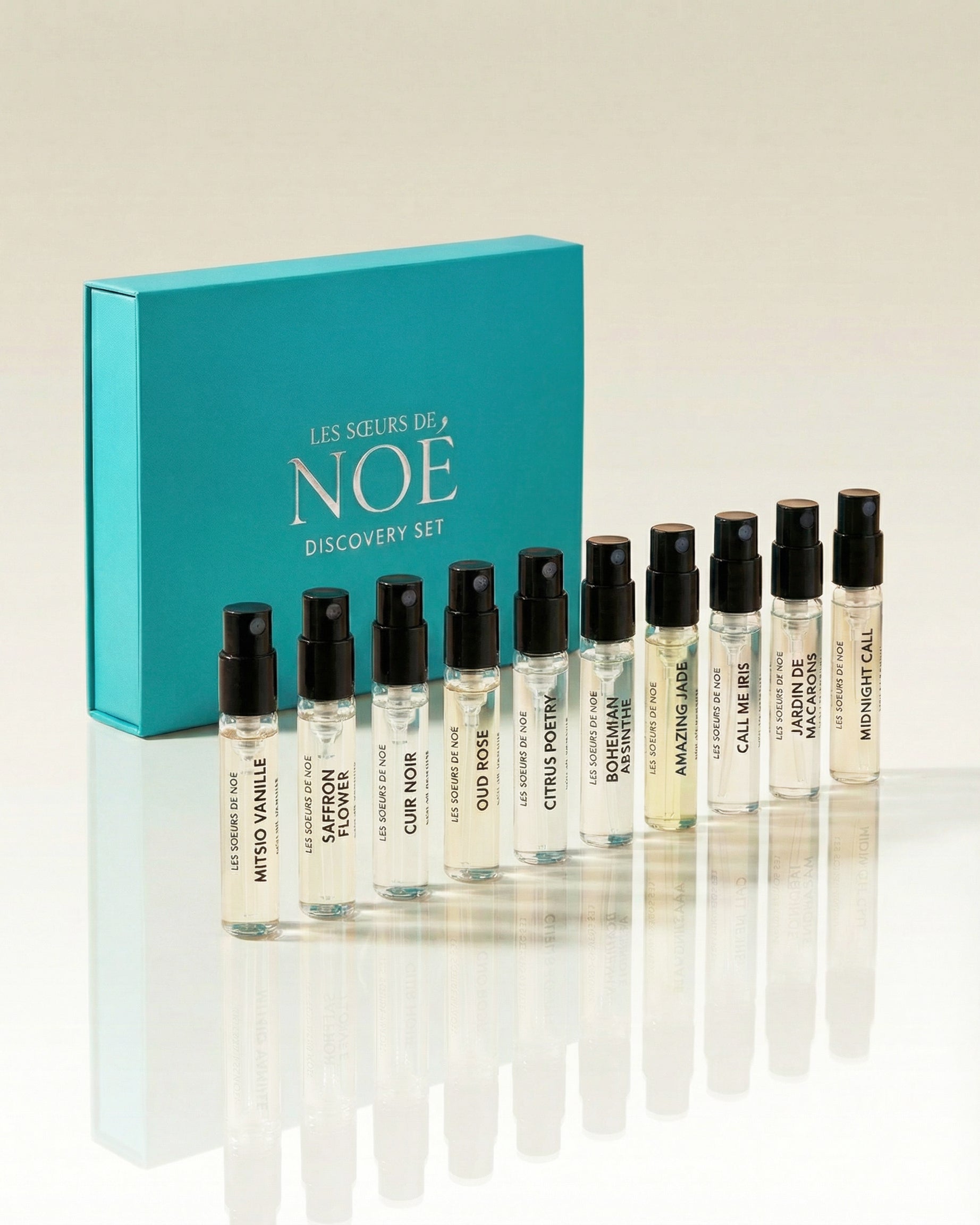
At Les Soeurs de Noé, you can begin with our Discovery Set, featuring ten 2 ml fragrances.
Or create a more personal selection with our Sample Box, choosing eight 2 ml samples yourself.
Both allow you to explore fragrances at home before committing to a full-size bottle.
For more on this approach, discover Why Discovery Sets Are the Smartest Way to Buy Perfume.
The Concentration Is a Number. The Fragrance Is an Experience.
Understanding perfume concentration helps you shop more intelligently.
You now know that EDT, EDP, Parfum and Extrait describe commonly used concentration categories, but they do not guarantee one fixed experience.
You know that a higher concentration does not automatically mean better quality, stronger projection or longer wear.
And you know that two perfumes with the same percentage can feel completely different.
So before choosing your next bottle, look beyond the concentration.
Experience the fragrance.
Wear it.
Give it time.
Notice how it develops.
And pay attention to the one you keep wanting to wear again.
Choose the perfume you love wearing, not simply the highest percentage.
Frequently Asked Questions
What does EDP mean in perfume?
EDP stands for Eau de Parfum. It is a fragrance concentration category that generally contains a higher proportion of fragrance concentrate than Eau de Toilette. There is no single universal EDP percentage, and the designation does not guarantee a specific level of projection or longevity.
What is a typical Eau de Parfum concentration?
Eau de Parfum is commonly found around the 10–20% concentration range, but there is no universal percentage that every fragrance house must follow. Concentration ranges overlap, so EDP should be understood as a useful category rather than a fixed technical standard.
What are the main perfume concentration levels?
The most commonly used fragrance concentration categories are Eau de Cologne, Eau de Toilette, Eau de Parfum and Parfum or Extrait de Parfum. They generally progress from lower to higher proportions of fragrance concentrate, although their percentage ranges can overlap and are not universally fixed.
What is the difference between EDP and EDT?
EDP generally contains a higher proportion of fragrance concentrate than EDT. However, the ranges overlap, and fragrance houses may formulate the two versions differently. Neither designation guarantees a particular smell, projection or duration.
Is Eau de Parfum stronger than Eau de Toilette?
Not necessarily in terms of projection or perceived intensity. An EDP generally contains more fragrance concentrate, but performance also depends on the composition and the materials used.
Does Eau de Parfum last longer than Eau de Toilette?
It can, but not always. Concentration is one factor in longevity. A particular EDT may remain perceptible longer than a particular EDP depending on their respective formulas.
Is Extrait de Parfum better than Eau de Parfum?
Not inherently. Extrait is generally associated with higher fragrance concentrations, but a higher percentage does not automatically mean better quality or a more enjoyable perfume. Choose according to the fragrance itself rather than assuming that the most concentrated option is superior.
Is 25% perfume concentration considered Extrait?
Not necessarily. The concentration ranges associated with Eau de Parfum and Extrait are industry conventions rather than universally fixed definitions. A fragrance house may designate a perfume formulated at 25% as an Eau de Parfum.
Does a higher concentration mean a perfume is safer for sensitive skin?
No. A higher concentration is not a guarantee of better skin tolerance. Fragrance ingredients, including natural materials, can cause irritation or sensitivity. If a product causes irritation, discontinue use.
Does concentration tell me whether a perfume contains natural ingredients?
No. Concentration refers to the proportion of fragrance concentrate in the finished product. It does not indicate the percentage of natural ingredients within that concentrate.
How do I know which perfume concentration is right for me?
Use concentration as a reference, not as the final decision. Consider how the fragrance smells, how it performs on your skin and whether you genuinely enjoy wearing it. Whenever possible, sample the perfume and experience how it develops before choosing a full-size bottle.


Leave a comment
This site is protected by hCaptcha and the hCaptcha Privacy Policy and Terms of Service apply.