

A perfume can disappear from your life for years.
Then one day, you smell it again.
And suddenly there is a room.
A person.
A particular summer.
A city you have not thought about in years.
You may remember how the light looked, what you were wearing or exactly how you felt.
All of it from something invisible.
This is one of the most extraordinary things about fragrance.
We do not experience scent through the nose alone. We experience it through memory, association, context and emotion.
Perhaps that is why perfume can feel so unusually personal.
The psychology of fragrance begins there: not with a list of notes, but with the relationship we create with what we smell.
Why Does Scent Feel So Emotional?
Our sense of smell has particularly close connections with brain systems involved in emotion and memory.
When we smell something, olfactory information is processed through a network that interacts closely with areas including the amygdala, which is involved in emotional significance, and structures associated with memory such as the hippocampal system.
This does not mean that scent bypasses thought, controls our emotions or produces the same psychological response in everyone.
It does help explain why smell can sometimes feel remarkably immediate.
You may encounter a fragrance before you have found the words to describe it and already know:
I love this.
This feels familiar.
This makes me uncomfortable.
This reminds me of someone.
Or simply:
This feels like me.
Fragrance can arrive as a feeling before it becomes a description.
Only afterwards do we begin searching for language.
Vanilla.
Iris.
Wood.
Rose.
Musk.
But the emotion may have arrived first.
Why Can Smell Bring Back a Memory So Suddenly?
 One of the most fascinating areas in the psychology of fragrance is olfactory memory: the relationship between smell and autobiographical experience.
Researchers have long studied the ability of odours to evoke personal memories, sometimes with striking emotional vividness.
This is often associated with what has become known as the Proust phenomenon.
Marcel Proust famously described how the taste and aroma of a madeleine dipped in tea opened the door to a world of childhood memories.
The literary moment became a useful metaphor for something many people recognise instinctively:
a smell can seem to recover a part of life that language had forgotten.
Perhaps it is the perfume someone close to you once wore.
The smell of a hotel lobby from an important journey.
Orange blossom from childhood summers.
A certain wood in a family home.
The fragrance you wore during a relationship.
Or the perfume you bought when something in your life was beginning to change.
The fragrance itself does not contain the memory.
You give the fragrance the memory.
And that distinction matters.
The Same Scent Does Not Mean the Same Thing to Everyone
There is no universal emotional dictionary of perfume.
Vanilla does not automatically mean comfort.
Rose does not automatically mean romance.
Citrus does not automatically mean energy.
Wood does not automatically mean calm.
Our responses to scent are shaped partly by what we have experienced before.
A note that feels reassuring to one person can feel completely unfamiliar to another.
A floral perfume might remind someone of a grandmother's garden.
For someone else, the same floral direction may recall a wedding.
Another person may have no specific memory attached to it at all and simply experience it as beautiful.
Culture, familiarity, personal preference, context and previous associations can all influence how an odour is perceived.
This is why talking about fragrance only through ingredients can sometimes feel incomplete.
Two people can smell the same perfume and encounter two entirely different emotional worlds.
The formula is shared. The experience is personal.
Can Perfume Actually Change Your Mood?
Scent can influence how we experience a moment.
A fragrance we find beautiful may feel comforting, energising, sensual, reassuring or simply pleasurable to wear.
But there is an important distinction between influence and prescription.
There is no reliable formula that says:
wear this note to become confident
or
smell this ingredient to become calm.
Research into scent and emotion repeatedly shows that personal preference, context and learned associations matter.
That is why the perfume that makes one person feel composed might make another feel nostalgic.
And a fragrance that makes you feel magnetic one evening may feel completely different when worn on a quiet morning.
Perhaps the more interesting question is not:
What is this perfume supposed to make me feel?
But:
What happens to me when I wear it?
That answer belongs to you.
Perfume Can Become Part of Identity
 We often speak about perfume as something we wear.
But over time, the relationship can begin to feel almost reversed.
A fragrance can become part of how we recognise ourselves.
You spray it before leaving home.
You notice it again on your scarf hours later.
Someone associates it with you.
You reach for it without thinking.
Eventually, it can begin to feel less like an accessory and more like part of your presence.
This is one reason the idea of a signature scent remains so compelling.
A signature fragrance is not necessarily the perfume that best describes your personality on paper.
It may simply be the one you repeatedly want near you.
The one that feels right across different versions of your life.
The one that makes you feel slightly more yourself.
Sometimes We Choose Perfume for the Person We Are Becoming
Not every perfume needs to reflect who you already are.
Sometimes fragrance is aspirational.
You may choose something more assertive before an important evening.
Something softer during a period when you want less noise.
Something unexpected because you are tired of smelling like the person you were five years ago.
A new perfume can mark a change without announcing it.
That is part of its intimacy.
You do not need to explain why you changed fragrance.
You simply begin wearing something different.
Sometimes identity follows.
Why Certain Perfumes Become Connected to Particular Chapters of Life
Think about the perfumes you remember most clearly.
Often, they are connected to something beyond the fragrance itself.
Your first important trip alone.
A wedding.
A new relationship.
A separation.
A new home.
A new job.
A summer that seemed to last forever.
When we repeatedly experience a scent within a particular context, associations can develop between that fragrance and what is happening around us.
Later, encountering it again may bring elements of that period back to mind.
Not because perfume stores a perfect recording of the past.
Memory is far more complex than that.
But fragrance can become one of the cues through which a period of life is remembered.
Can You Create an Olfactory Memory Intentionally?
You cannot decide exactly what a future smell will make you remember.
But you can choose to introduce a fragrance into a meaningful moment.
Some people buy a new perfume before travelling somewhere important.
Others reserve a fragrance for their wedding or for a particular season.
Some begin wearing something new when they move city, change career or enter a new chapter of life.
The idea is beautifully simple:
wear something unfamiliar while creating memories you hope will matter.
Years later, that fragrance may become part of the way you remember the period.
There is no guarantee.
That uncertainty is part of what makes the relationship between perfume and memory so fascinating.
Why Perfume Rituals Can Feel Powerful
 There is also psychology in the act of wearing perfume itself.
Opening the bottle.
Choosing where to spray.
The brief cloud in the air.
The first impression on skin.
These gestures can become part of a personal routine.
Before work.
Before dinner.
Before going somewhere important.
Before seeing someone.
A ritual does not need a measurable biological effect to matter.
Its meaning may come from repetition and intention.
Perfume can create a small transition between one part of the day and another.
A private moment before entering the public world.
Why Fragrance Changes as Our Lives Change
A perfume you adored at twenty may not speak to you at forty.
And something you once dismissed may suddenly feel extraordinary years later.
This does not necessarily mean the fragrance has changed.
You have.
Your references are different.
Your memories are different.
Your aesthetic may have changed.
Your relationship with sweetness, florals, woods or intensity may have evolved.
This is one reason perfume discovery never really ends.
There is always the possibility that a fragrance you would once have walked past becomes precisely the one you want now.
How to Discover What a Perfume Really Makes You Feel
When discovering a fragrance, try not to decide too quickly what it is supposed to mean.
Instead, notice your response.
Wear It on Skin
A blotter can introduce you to a composition.
Skin allows you to experience it as something you actually live with.
Give the fragrance time before deciding whether it belongs to you.
Wear It More Than Once
Your first impression matters, but it does not always tell the whole story.
Try the perfume on a different day, at a different hour or in a different setting.
You may notice another side of it.
Notice What You Want to Smell Again
There is a difference between appreciating a perfume and wanting to wear it.
You can admire something enormously without wanting it on your own skin.
The fragrance that keeps drawing you back is often more interesting than the one you simply think you should like.
Pay Attention to the Words That Arrive Naturally
Do not worry initially about identifying every note.
Ask instead:
Does it feel bright?
Intimate?
Polished?
Warm?
Magnetic?
Unexpected?
Does it remind you of somewhere?
Someone?
Or does it feel completely new?
Those responses can tell you as much about your relationship with the fragrance as a technical note list.
For a more detailed approach, read our guide to how to test perfume.
Discovery Is Part of the Psychology of Fragrance
 Sometimes the most interesting perfume is not the one you expected to choose.
That is why sampling several fragrances can be so revealing.
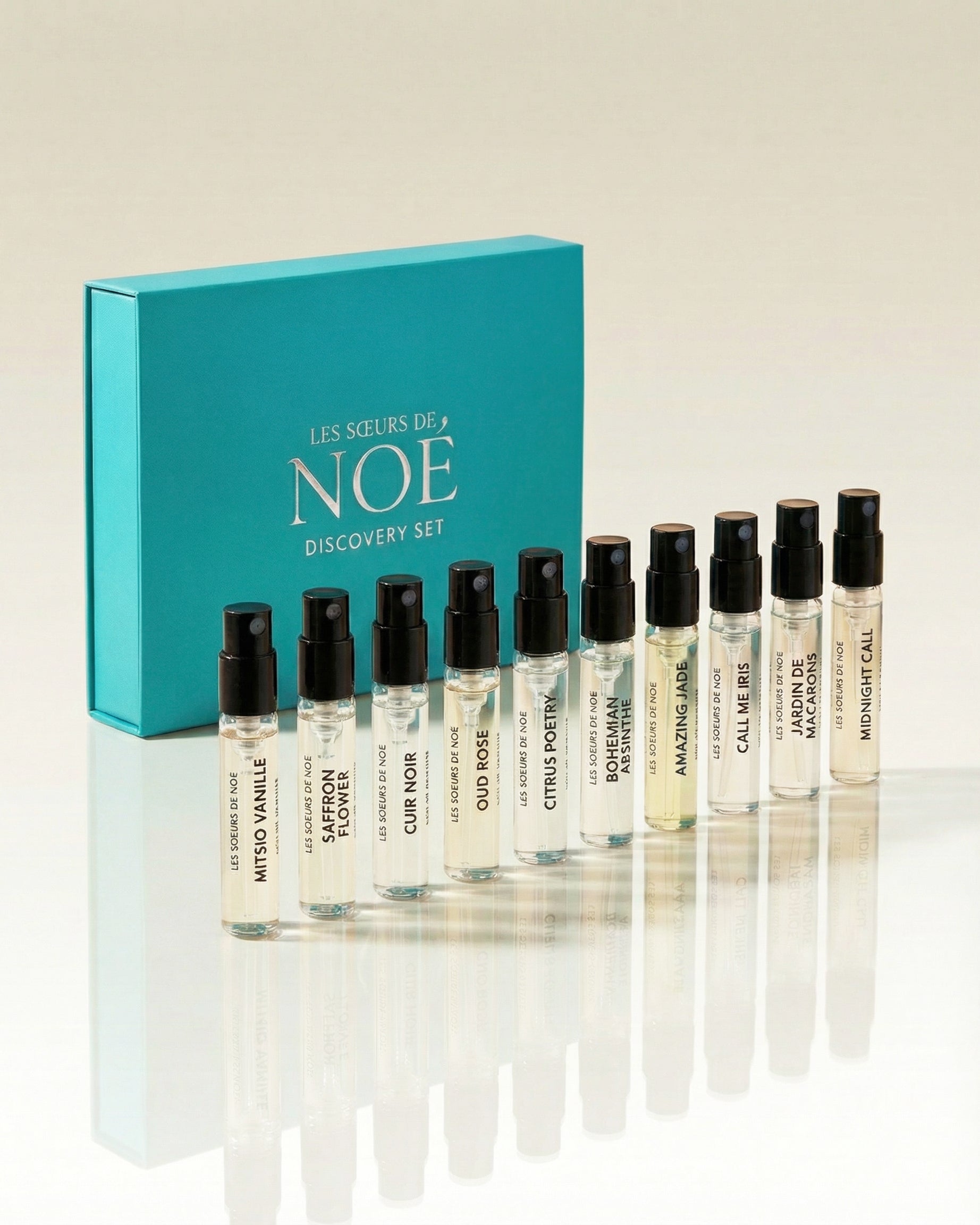
The Les Soeurs de Noé Discovery Set allows you to explore ten fragrances from the Signature Collection at home and on your own skin.
For a more personal selection, the Sample Box allows you to choose eight fragrances to discover in your own time.
There is no need to decide immediately.
Wear them.
Return to them.
Notice which one you think about after the scent has disappeared from your skin.
Sometimes desire reveals itself through repetition.
Fragrance, Emotion and Les Soeurs de Noé
At Les Soeurs de Noé, perfume is approached through emotion, memory and connection.
The fragrances are created in France in collaboration with Master Perfumer Jérôme Epinette and are designed as compositions to be experienced on skin rather than understood only through their individual notes.
The Maison's fragrances are vegan and cruelty-free and contain more than 85% ingredients of natural origin.
But no ingredient list can predict what a fragrance will eventually mean to the person wearing it.
That part happens afterwards.
In the morning when you reach for the bottle.
On the journey where you first wore it.
In the memory someone else begins attaching to your scent.
And perhaps years later, when you smell it unexpectedly and an entire chapter returns.
The Real Psychology of Fragrance Is Personal
 We often want perfume to give us answers.
Which notes are seductive?
Which fragrance will make me feel confident?
Which family suits my personality?
Which perfume will become my signature?
But fragrance may be more interesting when we allow some of those questions to remain open.
A perfume does not need to tell you who you are.
It does not need to control your mood.
And it does not need to mean the same thing to everyone.
A fragrance becomes meaningful because of what you bring to it.
Your memories.
Your preferences.
Your associations.
Your skin.
Your life.
Perhaps that is the real psychology of fragrance.
We do not simply smell perfume.
We give it a place in our story.
Frequently Asked Questions
Why does scent trigger memories so strongly?
Smell has close neural connections with brain systems involved in emotion and memory. Odours can therefore become powerful cues for autobiographical memories, particularly when they have been associated with meaningful people, places or experiences.
What is the Proust effect?
The Proust effect, or Proust phenomenon, describes the experience of a smell or flavour unexpectedly bringing back a vivid autobiographical memory. The name comes from Marcel Proust's famous literary description of memories returning after tasting a madeleine dipped in tea.
Can perfume change your mood?
Scent can influence emotion and mood, but responses vary significantly between people. Personal preference, previous associations and context all matter, so no individual perfume note can be expected to produce the same emotional effect in everyone.
Why does the same perfume feel different to different people?
Fragrance perception is personal. Familiarity, culture, memory, preference, context and individual perception can all influence the way someone experiences a scent. The same composition can therefore create very different associations for different people.
Can a perfume make you feel more confident?
A fragrance you personally associate with confidence, pleasure or a particular version of yourself may contribute to how you feel when you wear it. This is personal rather than universal: there is no specific ingredient that guarantees confidence.
Can wearing a perfume during a special moment help create a scent memory?
A fragrance repeatedly experienced during an important period can become associated with that context. Encountering the scent again later may then act as a cue for memories connected with that time, although memory is individual and no particular association can be guaranteed.
Should I choose a perfume according to its notes or according to how it makes me feel?
Both can help, but your lived response to the finished fragrance matters more than whether its note list looks perfect on paper. Test it on skin, wear it more than once and notice which fragrances you genuinely want to experience again.
How can I find a fragrance that feels like me?
Start by sampling different olfactive directions rather than trying to define your personality in advance. Pay attention to which fragrances feel natural to wear, which ones you keep thinking about and which ones you instinctively want to smell again.


Leave a comment
This site is protected by hCaptcha and the hCaptcha Privacy Policy and Terms of Service apply.