

A perfume description can look deceptively simple.
Bergamot.
Rose.
Vanilla.
Woods.
Four words, and yet the fragrance itself may smell nothing like the picture you formed in your head.
That is because a perfume composition is not a shopping list.
Notes interact.
Accords create impressions that no single ingredient could produce alone.
Some materials are perceptible immediately. Others become more noticeable as the fragrance develops.
And the words used to describe perfume, powdery, mineral, creamy, transparent, smoky, skin-like, often tell you as much as the note list itself.
Learning to read a perfume composition is therefore less about memorising ingredients and more about understanding structure, texture and contrast.
Here is how to do it.
Start With the Fragrance Family
Before analysing individual notes, look at the overall olfactive family.
A family gives you the broadest clue about the perfume's character.
You may encounter terms such as:
Floral
Woody
Fresh
Amber
Fruity
Gourmand
Aromatic
These categories are useful, but they are not rigid boxes.
A perfume may be floral and woody.
Fruity and gourmand.
Fresh with an amber drydown.
That overlap is often where a fragrance becomes interesting.
So instead of asking:
“Which family is this perfume?”
ask:
“Which families seem to shape its personality?”
If you want a deeper guide to these categories, read Fragrance Families Explained: How to Find the Ones You Love.
Then Look at the Notes, But Do Not Read Them Literally
A perfume note is a way of describing what you may perceive in a composition.
It is not always a literal ingredient.
If a fragrance lists:
pear
that does not necessarily mean pear extract was poured into the formula.
The perfumer may create the impression of pear through a combination of fragrance materials.
The same applies to many other descriptions.
Clean skin.
Sea air.
Suede.
Cashmere.
Mineral notes.
Warm milk.
These are olfactive effects.
That distinction changes the way you read a perfume page.
Instead of asking:
“Is this ingredient really inside?”
ask:
“What impression is the perfumer trying to create?”
What Do Top, Heart and Base Notes Mean?
The familiar olfactive pyramid divides a perfume into:
top notes
heart notes
base notes
It is a useful way to describe how a fragrance may evolve.
But it should not be treated as a strict timetable.
Perfume does not move through three perfectly separated stages.
Materials overlap.
Some remain perceptible much longer than expected.
Others appear early but continue to influence the composition in the background.
Think of the pyramid as a map, not a stopwatch.
Top Notes: The First Impression
Top notes help shape what you perceive at the beginning.
Citrus.
Aromatic herbs.
Bright fruits.
Fresh spices.
Certain light florals.
They can give a perfume energy, brightness or immediate character.
But the opening is only one part of the composition.
This matters when testing fragrance.
A perfume you love during the first minute may become less interesting later.
And a fragrance that initially surprises you may become beautiful once it settles.
Never judge the whole perfume from the opening alone.
Heart Notes: Where the Character Becomes Clearer
The heart often contains elements that help define the perfume's central identity.
Florals.
Spices.
Fruits.
Aromatic materials.
Textural accords.
This is where the relationship between the opening and the deeper parts of the fragrance often becomes clearer.
But again, there is no exact moment when the “heart begins.”
Fragrance development is continuous.
The useful question is:
What remains after the initial impression has softened?
That tells you far more than waiting for an arbitrary number of minutes.
Base Notes: The Foundation of the Composition
Base notes often include materials associated with depth, warmth or persistence.
Woods.
Musks.
Vanilla.
Resins.
Amber effects.
Earthy materials.
But base notes should not be treated as a simple predictor of longevity.
A perfume containing woods or musk does not automatically last longer than another fragrance.
Performance depends on the complete composition.
The base simply gives you clues about the direction of the drydown.
Will it become creamy?
Dry?
Woody?
Warm?
Skin-like?
Smoky?
That is what you should be looking for.
Learn to Read Accords

This is where perfume becomes much more interesting.
An accord is an olfactive effect created by several materials working together.
Think of music.
One note is one sound.
Several notes played together can form a chord.
Perfumery works in a similar way.
A perfumer might build:
a leather accord
an amber accord
a marine accord
a praline effect
a clean-skin accord
The result can feel recognizable even though no single raw material corresponds exactly to that smell.
When reading a perfume description, accords often tell you more about the finished fragrance than a long list of isolated ingredients.
Pay Attention to the Adjectives
One of the fastest ways to become better at reading fragrance descriptions is to stop focusing only on nouns.
Look at the adjectives.
Creamy vanilla tells you something different from dry vanilla.
Juicy pear feels different from crisp pear.
Velvety rose suggests something different from dewy rose.
These words describe texture and mood.
You may encounter:
powdery - soft, cosmetic, sometimes iris- or violet-like
creamy - smooth, rounded, enveloping
dry - less sweet, sometimes woody or mineral
green - leafy, grassy, stem-like or crisp
smoky - charred, incense-like or dark
balsamic - warm, resinous, sometimes sweet
mineral - cool, stony, salty or abstract
transparent - airy rather than dense
These descriptions help you imagine how the ingredients are being presented.
Contrast Often Creates the Signature
A perfume does not become interesting simply because every note is beautiful.
Sometimes what gives it identity is the contrast.
Fresh against warm.
Juicy against dry.
Floral against woody.
Sweet against mineral.
Bright against smoky.
That tension can create movement within a fragrance.
Imagine an apple-vanilla perfume.
If both elements are soft and sweet, the fragrance may feel very rounded.
Add something crisp or luminous between them and the composition changes entirely.
When reading a note list, look for those contrasts.
They often tell you where the personality lies.
Natural and Synthetic Materials Belong to the Same Palette
A composition may contain natural materials, synthetic fragrance materials or both.
That information can matter to you.
But it does not allow you to predict quality simply from origin.
Natural materials can bring extraordinary nuance.
Modern fragrance molecules can create transparency, texture, diffusion or olfactive effects that would be difficult to obtain through traditional extraction.
The perfumer works with the complete palette.
At Les Soeurs de Noé, our compositions contain more than 85% ingredients of natural origin, while modern fragrance materials also contribute where they serve the creation.
If you want to explore this subject in more detail, read Natural vs Synthetic Ingredients in Perfume: What Really Matters?.
Concentration Is Useful Information, Not a Quality Score
You may also see:
Eau de Toilette
Eau de Parfum
Extrait de Parfum
These terms give you information about fragrance concentration.
But they should not be interpreted as a ranking from ordinary to luxurious.
A higher concentration does not automatically mean:
better quality
stronger projection
longer wear
greater complexity
Different formulas behave differently.
The materials themselves matter.
So does the structure of the composition.
If you want a deeper explanation, read Perfume Concentration Explained: EDP, EDT and More.
Sillage and Longevity Are Not the Same Thing
These two terms are frequently confused.
Longevity describes how long you continue to perceive the fragrance.
Sillage describes the trail or spatial presence associated with the perfume as you move.
A fragrance can stay relatively close to the skin for a long time.
Another can feel more expansive at first and then become quieter.
Neither behaviour is automatically better.
The question is:
What kind of presence do you enjoy?
Some people want intimacy.
Others enjoy a more noticeable trail.
Reading reviews or descriptions can provide clues, but performance is difficult to predict perfectly from a note list.
Projection Is Another Piece of the Puzzle
Projection refers broadly to how far a fragrance seems to radiate from the wearer.
Again, it is not synonymous with quality.
A beautiful perfume can sit close to the skin.
Another can have a more expansive presence.
The right choice depends on what you want from the fragrance.
For work.
For dinner.
For yourself.
For a room full of people.
There is no universally correct level of projection.
Why Perfume Can Feel Different Once You Wear It

A fragrance does not exist in a vacuum.
Temperature.
Humidity.
Skin surface.
Application.
Sensory perception.
All can influence the way you experience it.
That does not mean your skin magically transforms the formula into a completely different perfume.
But the release and perception of its different facets can vary.
This is one of the reasons a blotter is useful for comparison while skin remains important for deciding whether you actually want to wear the fragrance.
Read more in Why Does the Same Perfume Smell Different on Everyone?.
How to Read a Perfume Page Online
Now put everything together.
Imagine a description that says:
Fragrance family: Floral Woody
Opening: juicy pear and bergamot
Heart: iris and soft florals
Base: musk and woods
Description: luminous, creamy, intimate
Do not simply think:
pear + iris + musk.
Read the whole picture.
The pear and bergamot suggest brightness.
The iris may introduce softness or a powdery texture.
The woods and musk suggest a softer, more grounded drydown.
And the words luminous, creamy, intimate tell you how the brand wants you to experience the composition.
Now you are reading the fragrance.
Not just its notes.
What a Note List Cannot Tell You
This may be the most useful thing to learn.
A note list cannot tell you exactly what a perfume smells like.
It cannot show you proportion.
Perhaps the vanilla is dominant.
Perhaps it is barely noticeable.
Perhaps the rose is central.
Perhaps it only adds texture.
And two perfumes listing the same three notes can smell completely different.
The formula determines the result.
That is why note lists are excellent for orientation.
They are not substitutes for smelling.
Use Descriptions to Build a Shortlist
This is where reading compositions becomes genuinely useful.
Instead of trying to blind-buy perfectly from a screen, use the information to narrow your choices.
Maybe you notice that you repeatedly gravitate toward:
bright fruits with woods
soft florals with musk
vanilla without excessive sweetness
green compositions
powdery iris
ambery fragrances with freshness
That is valuable.
You are beginning to identify patterns in what you enjoy.
And those patterns make perfume discovery much easier.
Then Let Your Skin Make the Final Decision
There is a point where analysis should stop.
You have read the family.
The notes.
The accords.
The textures.
The concentration.
Now smell it.
A perfume is ultimately a sensory experience.

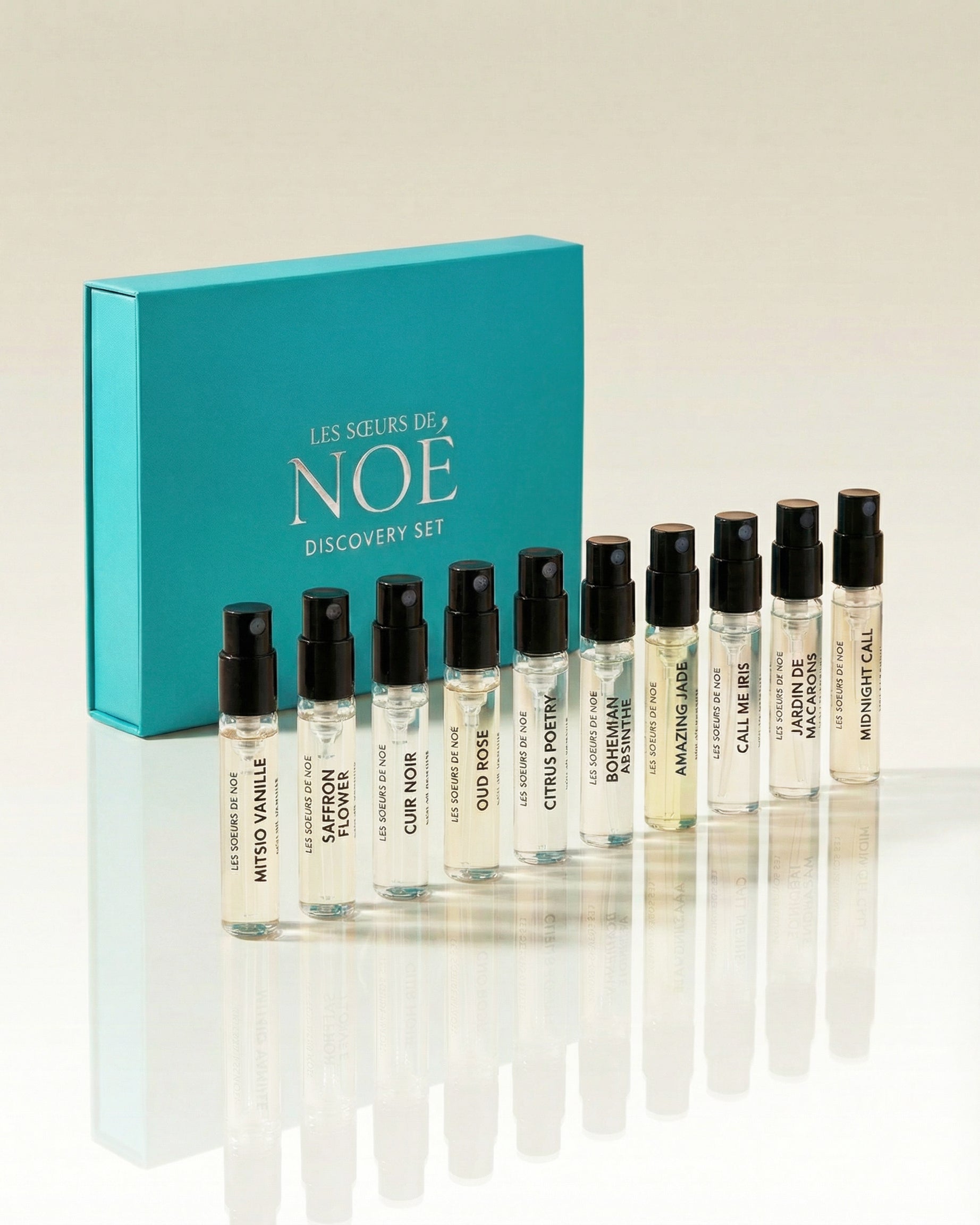
At Les Soeurs de Noé, you can explore the collection before choosing a full bottle.
Discovery Set
10 × 2 ml - €55
Discover ten fragrances from the Signature Collection and compare different olfactive directions at home.
The Discovery Set includes a €50 voucher toward an eligible order over €150.
Sample Box
8 × 2 ml - €50
Already have a shortlist?
Choose eight samples yourself and experience the fragrances that interest you most.
The Sample Box also includes a €50 voucher toward an eligible order over €150.
Then compare.
Wear them at different moments.
Return to them.
And notice something very simple:
Which one do you miss when you are not wearing it?
That is often more revealing than any note list.
Read the Composition. Then Forget It.
Learning the language of perfume makes discovery easier.
You begin to understand:
families
notes
accords
textures
contrasts
concentration
sillage
longevity
But expertise does not mean analysing every fragrance forever.
It means knowing how to use the information and knowing when to stop.
Read the composition.
Understand its direction.
Build your shortlist.
Then wear the perfume.
Because eventually, the most important question is not:
“Can I explain this fragrance?”
It is:
“Do I want to smell it again?”
Frequently Asked Questions
What are top, heart and base notes?
They are a useful way of describing how different facets of a perfume may become more or less noticeable as the fragrance develops. They should be understood as an approximate structure rather than fixed stages with exact timings.
What is an accord in perfume?
An accord is an olfactive effect created by several fragrance materials working together to produce a recognizable impression.
Are perfume notes actual ingredients?
Not always. Some notes correspond to identifiable natural materials, while others describe an impression constructed from several fragrance materials.
Can I predict a perfume's longevity from its base notes?
Not reliably. Base notes can give clues about the direction of the drydown, but longevity depends on the entire composition.
Does a higher perfume concentration mean better quality?
No. Concentration is one characteristic of a fragrance and does not by itself determine quality, longevity or projection.
What is the difference between sillage and longevity?
Longevity refers to how long a fragrance remains perceptible. Sillage refers to the trail or spatial presence associated with the fragrance.
What does “powdery” mean in perfume?
Powdery describes a soft, cosmetic or velvety olfactive sensation often associated with materials or accords such as iris and violet.
Why can two perfumes with the same notes smell completely different?
Because the proportions, materials, accords and overall formula can be entirely different. A note list does not reveal the complete construction.
How should I choose perfume online?
Use fragrance families, notes, accords and descriptive language to build a shortlist, then sample the fragrances whenever possible before committing to a full bottle.
What is the best way to understand a perfume composition?
Learn enough to understand its direction, then experience the finished fragrance on your own skin.


Leave a comment
This site is protected by hCaptcha and the hCaptcha Privacy Policy and Terms of Service apply.